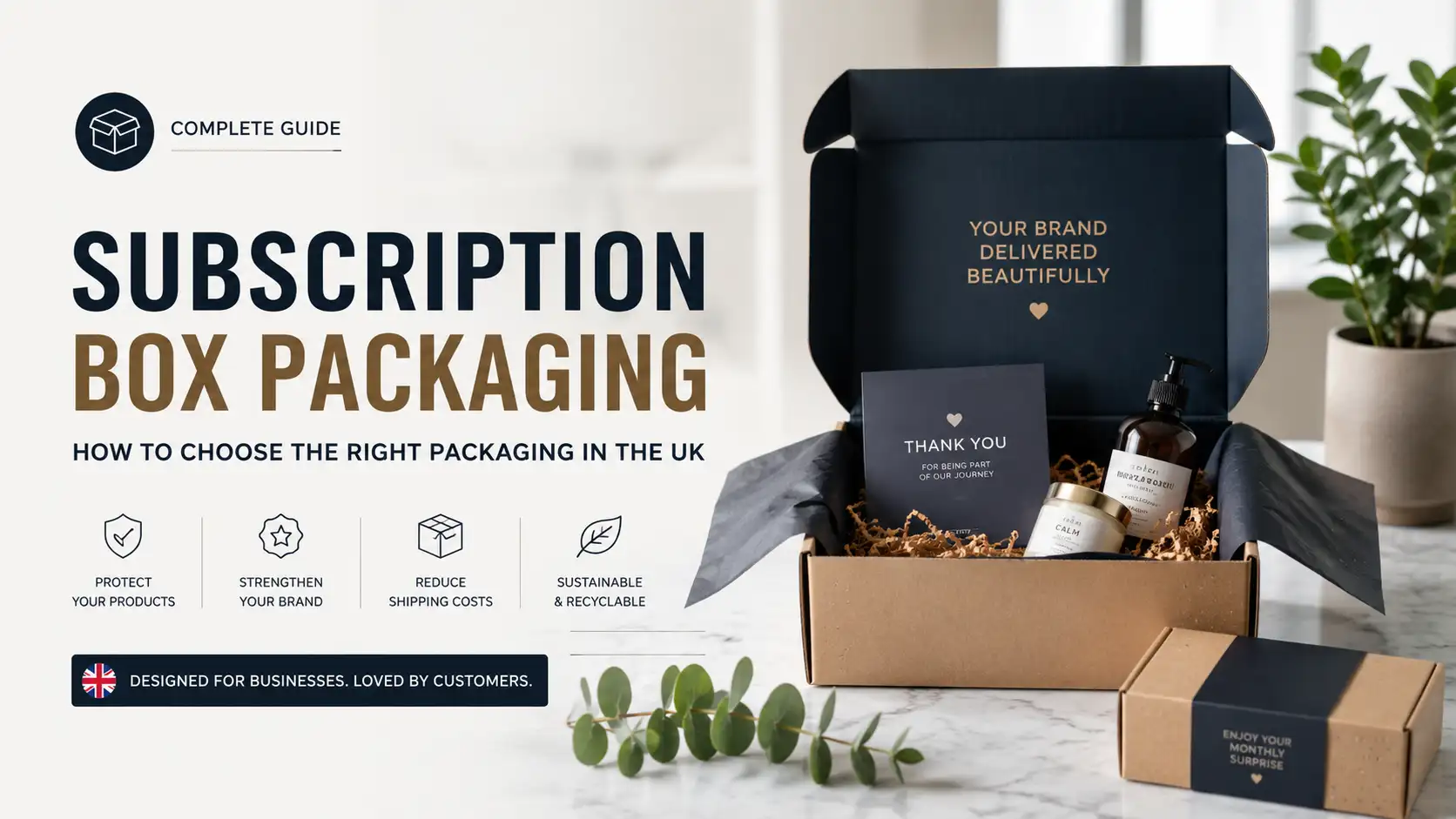
Subscription box packaging can look impressive and still cost your business money. An oversized box increases postage, storage needs, and void fill. A weak box may lead to damaged items. A complicated design can slow down packing when monthly orders increase.
The best packaging for subscription boxes balances five things:
- Product protection
- Postage size
- Packing speed
- Brand presentation
- Cost per delivered order
Start with the products and delivery process, not the artwork. Once the practical details are correct, the design can turn each delivery into a branded experience customers remember.
What Makes Good Subscription Box Packaging?
Good Subscription box packaging protects the contents, arrives in a presentable condition, and remains easy to pack repeatedly.
It should also match the way your business operates. A small skincare subscription has different needs from a coffee club, pet box, or monthly stationery set.
A reliable packaging setup usually includes:
- A box sized around the packed products
- Enough board strength for delivery
- Inserts where items need support
- Simple opening and closing
- Clear branding inside and outside
- A size that fits the chosen postal service
- Materials that are practical to recycle
- A repeatable design for future orders
The most expensive-looking option is not always the best. Packaging must first work at the packing table and throughout delivery.
Start With the Products Inside the Box
Before comparing subscription box packaging ideas, list everything that may go inside each delivery.
Measure the products together in their final packed position. Include tissue paper, protective wraps, cards, samples, and inserts. Measuring each item separately can lead to a box that looks correct on paper but is too tight during fulfilment.
Consider these factors:
| Product detail | Packaging decision |
| Heavy products | Stronger board and reinforced folds |
| Glass bottles or jars | Dividers or fitted inserts |
| Products with pumps or lids | Extra clearance around fragile points |
| Flat products | Slim mailer or folding carton |
| Mixed product sizes | Flexible compartments or dividers |
| Monthly product changes | Less restrictive internal layout |
| Food or drink items | Suitable barrier and contact requirements |
| Premium products | Cleaner internal presentation and finishes |
Always measure the largest version of a product. Labels, caps and filled containers can be slightly wider than technical product drawings suggest.
For subscription plans with different quantities, two or three standard box sizes are often easier to manage than one large box filled with excess material.
Choose the Right Subscription Box Size
Choosing the correct size can reduce movement, packaging waste and postage costs.
The box needs enough internal room for easy packing, but not so much that items slide around. Too little space can crush products, tear tissue paper or make the box difficult to close.
Internal and External Dimensions Are Different
Packaging suppliers may request either internal or external measurements.
- Internal dimensions show the usable space inside the box. These matter when fitting products and inserts.
- External dimensions show the total size after the box is assembled. These matter for postage, storage, and courier limits.
Board thickness affects the difference between the two. A Corrugated box may have more noticeable thickness than a standard folding carton.
Confirm which dimensions your supplier needs before approving the order.
Pack and Measure a Complete Test Order
Build a sample order using the real products and protective materials. Close the parcel and record:
- External length
- External width
- External depth
- Total packed weight
- Space around the products
- Time required to pack and close it
Do not rely only on estimated product dimensions. A fully packed test order gives a more realistic result.
Check UK Postage Sizes Before Designing the Box
Postage should be considered before the artwork and structure are finalised.
A difference of only a few millimetres can move a parcel into a more expensive postal category. The depth measurement is especially important for slim subscription packages.
Royal Mail currently lists the following common limits:
| Royal Mail format | Maximum dimensions | Common weight limit |
| Large Letter | 353mm x 250mm x 25mm | Up to 750g for standard services |
| Small Parcel | 450mm x 350mm x 160mm | Up to 2kg |
Some tracked services may have different weight allowances, so check the exact service used by your business before ordering packaging.
Letterbox Subscription Box Dimensions
A slim subscription box may qualify as a Royal Mail Large Letter when it remains within the stated size and weight limits.
However, a Large Letter postal format does not guarantee that the parcel will pass through every residential letterbox. Home letterbox openings can vary, and rigid packaging may be less flexible than an envelope.
Products that may work well in a slim format include:
- Socks
- Stationery
- Printed materials
- Fabric samples
- Tea sachets
- Small beauty samples
- Flat craft kits
- Lightweight accessories
The complete packed box must stay within the depth limit. Tissue, cards, product bulges, and closure tabs all count towards the final measurement.
Use a postal size gauge or send completed samples through the intended delivery service before approving a large production run.
Compare the Main Box Styles
The best box style depends on product weight, delivery method, and the experience you want to create.
| Box style | Best used for | Main consideration |
| Corrugated mailer box | Ecommerce and courier delivery | Strong and easy to brand |
| Folding carton | Small, light or retail-style products | May need an outer mailer |
| Tuck-end box | Lightweight products and samples | Simple but less protective |
| Sleeve box | Premium presentation and themed campaigns | Usually needs another structure |
| Rigid box | Luxury products, gifts and PR boxes | Higher cost and storage needs |
| Magnetic box | Premium collections and reusable packaging | Often unsuitable for low-cost postage |
| Custom die-cut box | Unusual products or branded openings | More setup and testing required |
Corrugated Mailer Boxes
Corrugated subscription mailer boxes are usually the most practical option for direct-to-customer deliveries.
The fluted inner layer improves strength without requiring a separate shipping carton in many cases. Mailer boxes also provide a large printable area and can be designed for quick assembly.
They are commonly used for:
- Beauty subscriptions
- Food and snack selections
- Coffee and tea clubs
- Pet products
- Books and stationery
- Wellness products
- Clothing and accessories
- Mixed ecommerce bundles
Folding Cartons
Folding cartons work well for lightweight products and slim subscription packs. They are usually more compact to store before assembly.
However, they may not provide enough protection for courier delivery on their own. An additional mailing bag or outer box may be needed, which can increase labour and material use.
Rigid and Magnetic Boxes
Rigid packaging creates a more premium unboxing experience. It can suit high-value memberships, influencer boxes, corporate kits and limited collections.
The trade-offs include:
- Higher unit cost
- More warehouse space
- Greater packed weight
- Higher postage risk
- Longer assembly or packing time
- Less efficient flat storage
Use rigid packaging when the presentation supports the subscription price and customer expectations.
Choose the Best Material for Subscription Boxes
Material should be selected according to product weight, fragility, delivery conditions, and brand position.
Corrugated Board
Corrugated board is often the best material for subscription boxes sent through courier and postal networks.
It offers:
- Good protection for its weight
- Resistance to crushing
- Suitable surfaces for printing
- Different strength options
- Flat storage before assembly
- Recyclable board choices
The correct board grade depends on the size and weight of the packed order. A lightweight stationery box does not need the same construction as a box containing glass jars.
Cardboard and Folding Boxboard
Cardboard is useful for smaller, lighter products. It can produce clean print results and neat retail-style folds.
It is often chosen for:
- Samples
- Cosmetics
- Accessories
- Cards and stationery
- Slim product collections
- Inner product boxes
It may need additional protection when sent without an outer mailer.
Kraft Board
Kraft board provides a natural, simple appearance and works well for handmade, food, wellness and craft brands.
Kraft material does not automatically make packaging sustainable. Coatings, laminations, inserts, adhesives and excessive sizing can still affect the environmental impact.
A simple kraft mailer with one-colour printing may be more suitable than a heavily laminated box covered with environmental claims.
Rigid Board
Rigid board supports premium presentation and reuse. It is best suited to subscriptions where the packaging forms part of the product value.
It is less suitable when low postage cost, flat storage and quick assembly are the main priorities.
Use Inserts to Protect and Present Products
Subscription box inserts keep products in planned positions during delivery. They can prevent bottles from colliding, stop small items from gathering in one corner, and make the box look organised when opened.
Common insert options include:
- Die-cut paperboard inserts
- Corrugated dividers
- Folded card supports
- Bottle and jar compartments
- Removable trays
- Card and sample slots
- Layered presentation sections
- Moulded fibre inserts
An insert should hold the product securely without making it difficult to remove.
Allow for normal changes in labels, filled product sizes and hand packing. An insert built around an exact digital measurement may become too tight when used with the actual product.
Provide physical product samples where possible. At minimum, supply accurate measurements of every cap, pump, lid and label.
When Inserts Are Not Needed
Not every subscription needs a fitted insert.
Tissue paper, paper padding or simple dividers may be better when:
- Product sizes change every month
- Items are soft or unbreakable
- The box contains clothing
- Packing speed is more important than fixed presentation
- The subscription is still being tested
- Customers receive different product combinations
A flexible layout can reduce the need to redesign packaging whenever the product selection changes.
Design the Unboxing Experience Around the Customer
A strong subscription box unboxing experience does not require every available print finish.
The design should make the delivery recognisable, easy to open and pleasant to explore.
Use the Outside for Recognition
The outer design can include:
- Brand colours
- Logo
- Simple pattern
- Handling information
- Return details
- Recycling instructions
- A discreet social media reference
Avoid placing important artwork where labels or courier stickers will cover it.
Dark colours and large solid print areas can show scuffs more clearly during delivery. A busy courier network may leave marks even when the box remains structurally sound.
Use the Inside for Engagement
Inside printing often creates more impact because it remains protected during transit.
Useful internal elements include:
- A welcome message
- Product instructions
- A thank-you note
- A QR code
- Referral information
- Renewal details
- A campaign hashtag
- Recycling guidance
- A seasonal message
- A printed pattern beneath the products
Keep messages short. Customers should understand the box without reading several paragraphs before reaching the products.
Choose Finishes With a Clear Purpose
Popular finishes include:
- Matte coating
- Gloss coating
- Soft-touch lamination
- Spot UV
- Foil stamping
- Embossing
- Debossing
- Anti-scratch lamination
One well-chosen finish can create a stronger result than several effects competing for attention.
For example, a small foil logo may suit a premium skincare brand. A one-colour print on kraft board may better match an independent coffee or craft subscription.
Make Packaging Easier to Fulfil
Packaging that looks good but takes too long to assemble can become expensive as subscriber numbers grow.
Before placing a bulk order, ask several team members to pack complete test boxes. Record the time and note where problems occur.
Check whether:
- The box opens easily from a flat position
- Folding points are clear
- Tabs lock without tearing
- Products fit without force
- Inserts remain in position
- Tissue and cards can be added quickly
- The box closes securely
- Labels sit on a flat surface
- Barcodes scan correctly
- Packed boxes stack safely
A saving of a few seconds per order can become valuable across hundreds or thousands of monthly shipments.
Complicated packaging may also increase training time and packing errors. A simpler structure often delivers better long-term value.
How to Reduce Subscription Box Shipping Costs
The cheapest box is not always the option with the lowest unit price.
Calculate the full cost of each delivered order:
Packaging cost + insert cost + packing time + postage + storage + damage replacements
A slightly stronger or better-fitting box may reduce total costs if it prevents damaged products and lowers postage.
Practical Ways to Lower Costs
- Design around a postal category
Confirm size and weight limits before selecting the box. - Remove unnecessary empty space
Right-sized boxes use less board and void fill. - Create two or three standard sizes
Use different sizes for small, standard and premium subscriptions. - Avoid double boxing where possible
A strong printed mailer may provide presentation and delivery protection in one structure. - Reduce packed weight
Review heavy inserts, thick cards and decorative items that add cost without improving protection. - Improve assembly speed
Self-locking structures can reduce tape use and packing time. - Test board strength carefully
Over-specified board adds weight and cost. Under-specified board leads to damage. - Order quantities around real demand
Larger orders may reduce unit cost, but unused boxes take up storage space and can become outdated. - Keep seasonal changes flexible
Use sleeves, cards, or stickers instead of changing the complete box for every campaign. - Review courier pricing regularly
Compare the packed dimensions and weight against available business services.
Choose Sustainable Packaging Without Vague Claims
Sustainable subscription box packaging should reduce waste without weakening product protection.
Damaged products create replacement shipments, extra transport, and more packaging. The lightest box is not sustainable if it regularly fails during delivery.
Look for practical improvements such as:
- Right-sized structures
- Recyclable paper-based materials
- Reduced plastic components
- Paper-based inserts
- Minimal void fill
- Fewer mixed materials
- Clear recycling instructions
- Designs that use less ink and lamination
- Reusable packaging where reuse is realistic
- Strong enough board to prevent damage
Ask the packaging supplier for clear information about:
- Board composition
- Recycled content
- Material certification
- Coatings
- Laminations
- Adhesives
- Inks
- Insert materials
- Local recyclability
Words such as green, natural and eco-friendly should be supported by a clear material specification.
Test Before Ordering a Full Production Run
A digital mock-up helps with artwork, but it cannot show how the packaging performs during real packing and delivery.
Test a physical sample with the final products.
A useful test should include:
- Packing the box several times
- Weighing the completed parcel
- Checking external dimensions
- Testing label placement
- Shaking the closed box
- Stacking multiple packed boxes
- Opening it without instructions
- Checking product movement
- Reviewing scuff visibility
- Sending it through the intended carrier
Ask someone who was not involved in the design to open the sample. Their reaction may reveal unclear tabs, difficult openings, or messages customers may miss.
OneStep CustomBoxes provides custom subscription packaging in corrugated board, rigid board, cardboard, kraft, and recyclable stock. Available options include custom dimensions, inserts, inside printing, CMYK or Pantone colours, digital or offset printing, and 3D proofs. The company currently supports orders starting from 100 boxes and states a 6 to 10 working day delivery window, subject to the order requirements and artwork approval.
Common Subscription Packaging Mistakes
Avoid these problems before production begins:
- Choosing the box before confirming postage limits
- Measuring products without protective materials
- Confusing internal and external dimensions
- Ordering one oversized box for every subscription tier
- Using weak board for heavy products
- Adding inserts that are too tight
- Covering barcode areas with patterns or finishes
- Using too many premium effects
- Making environmental claims without material details
- Ordering large quantities before testing fulfilment
- Ignoring warehouse storage space
- Designing artwork without considering courier labels
- Approving colours only from a computer screen
- Failing to test the completed parcel through delivery
These mistakes often appear small during design but become costly when repeated every month.
Choose Packaging That Works Every Month
The right subscription box packaging should protect products, control postage costs and make fulfilment easier. It should also give subscribers a consistent experience every time an order arrives.
Begin with the packed products, delivery method and fulfilment process. Then choose the material, structure and design that support them.
For custom subscription box sizes, branded mailer boxes, inserts or printed finishes, Request a quote from OneStep CustomBoxes. Share your product dimensions, packed weight, quantity and preferred style so the team can recommend a practical packaging setup.
Frequently Asked Questions
1. What is the best packaging for subscription boxes?
Corrugated mailer boxes are a practical choice for most postal subscriptions because they offer protection, printable surfaces and simple assembly. The best option still depends on product weight, fragility, size and delivery method.
2. How do I measure products for a subscription box?
Arrange all products in their final packed position. Include inserts, tissue paper, cards and protective materials. Measure the complete group and add enough space for easy packing without leaving unnecessary empty areas.
3. What are the Royal Mail Large Letter dimensions?
A standard Royal Mail Large Letter can measure up to 353mm long, 250mm wide and 25mm deep. The usual standard weight limit is 750g, although some tracked services may have different allowances. Always check the selected service before production.
4. Can a subscription box fit through a letterbox?
Slim products may be packed within Large Letter dimensions, but residential letterboxes are not all the same size. Test the complete package rather than assuming a postal format will fit through every door.
5. How can small businesses reduce subscription box postage costs?
Choose packaging around the postal category, reduce empty space, control packed weight and use a small range of standard box sizes. Calculate postage together with packing time, storage and damage costs.
6. Do subscription boxes need inserts?
Inserts are useful for fragile, heavy or mixed products that may move during delivery. Flexible subscriptions containing soft or regularly changing products may only need tissue, paper padding or simple dividers.
7. Is kraft packaging always more sustainable?
No. Sustainability also depends on sizing, coatings, laminations, adhesives, inserts, and recyclability. Ask for a complete material specification rather than judging the box by its brown appearance.
8. Should I order a sample before buying custom boxes?
Yes. A physical sample allows you to test product fit, assembly, packed weight, label placement, box strength and the customer opening experience before committing to a larger quantity.