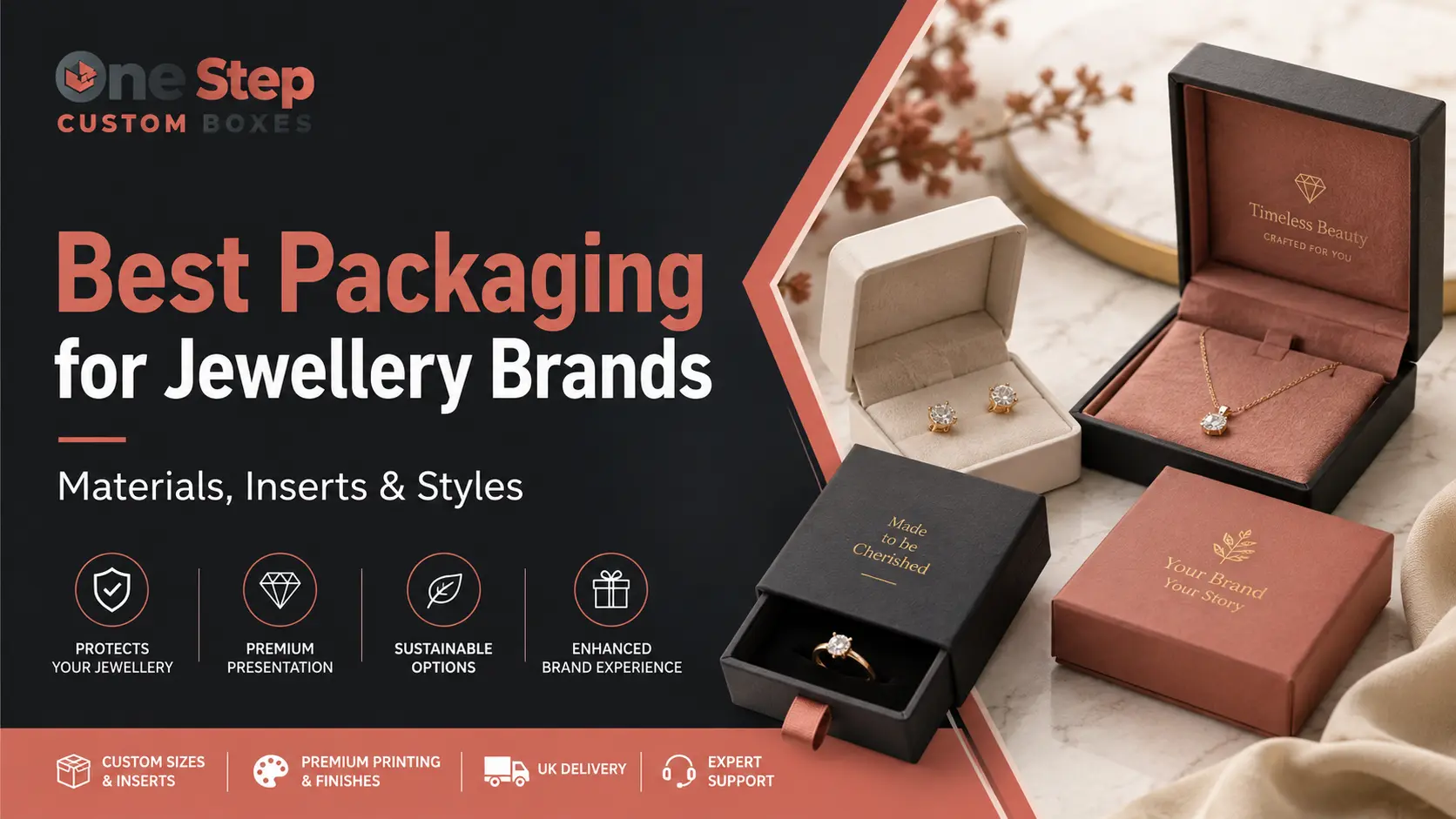
Choosing the best packaging for jewellery depends on more than how the box looks. Jewellery is small, delicate, and often high in perceived value, so the packaging needs to protect each piece while creating a presentation that feels right for the brand.
A good jewellery box should keep the product secure, suit its shape, fit the way it is sold and support a smooth unboxing experience. For a small online jewellery business, that might mean a compact printed box with a secure insert. A premium jewellery brand may prefer a rigid box with a soft-touch finish and a tailored velvet insert.
The right choice comes down to the jewellery, the delivery method, the customer experience and the image you want your packaging to create.
What Is the Best Packaging for Jewellery?
The Best packaging for jewellery is packaging that provides a secure fit, protects the item from movement and scratching, and presents it in a way that suits the product and brand. The box should also be practical to store, pack, and ship without adding unnecessary size or weight.
A useful starting point is to assess five things:
- Type of jewellery: Rings, necklaces, earrings, bracelets and sets need different internal support.
- Product value: Premium pieces often need a more structured and presentation-led box.
- Shipping method: Jewellery sent by post needs stronger outer protection and a secure internal fit.
- Brand identity: Packaging should reflect whether the brand is minimalist, luxury, handmade, modern or eco-focused.
- Budget and order volume: Small businesses may need a balance between presentation, storage and cost.
OneStep CustomBoxes offers custom jewellery packaging designed around different product shapes, materials, inserts and finishes, including options for rings, earrings, necklaces and bracelets.
Which Jewellery Packaging Materials Are Best?
The best material depends on the level of protection, presentation and sustainability you need. Cardboard and Kraft can work well for lightweight everyday packaging, while rigid board is better suited to structured, premium presentation boxes.
| Material | Best for | Main advantage | Consideration |
| Cardboard | Everyday jewellery, retail orders | Lightweight and versatile | May need an insert for delicate pieces |
| Kraft | Handmade and eco-conscious brands | Natural appearance | Less suited to every luxury aesthetic |
| Rigid board | Premium and luxury jewellery | Strong, structured presentation | Usually bulkier than folding packaging |
| Corrugated board | Shipping and outer protection | Good cushioning and strength | More functional than luxury-focused |
| Eco-stock | Sustainability-focused brands | Supports a lower-impact packaging approach | Finish and structure should be matched to the product |
The key is not simply choosing the thickest material. Packaging should use enough material to protect the jewellery without creating unnecessary volume. UK government guidance also states that packaging should use the minimum weight and volume needed to keep the product safe and hygienic.
For a brand selling delicate necklaces online, for example, a lightweight presentation box with a properly fitted insert may be more practical than an oversized rigid box.
Different Types of Jewellery Boxes to Consider
There is no single jewellery box style that works for every product. The internal structure matters just as much as the external appearance.
Ring Boxes
Ring boxes are compact and usually include a dedicated slot or cushion to hold the ring securely. They work well for individual rings, wedding jewellery, gifts and small premium pieces.
A loose ring inside a large empty box can move around during handling, reducing both protection and presentation. A fitted insert creates a cleaner product display and keeps the jewellery in position.
Necklace Boxes
Necklaces need more attention to movement and chain tangling. A box with a shaped insert, tabs, or a dedicated internal structure can help keep the chain positioned correctly.
For longer necklaces, the internal dimensions should be checked carefully before production. The box needs enough room for the product without leaving large empty areas where the chain can move.
Earring Boxes
Earring packaging benefits from separation. Pairing the earrings with a fitted card or insert makes the presentation cleaner while helping prevent pieces from knocking against each other.
Bracelet and Bangle Boxes
Bracelets and bangles generally require more internal width than rings or earrings. Some products may benefit from foam, velvet cushions, die-cut placeholders, or compartments to keep them properly positioned. Custom bangle packaging can also use tailored dimensions and multiple insert options.
Jewellery Set Boxes
Jewellery sets may combine a necklace, earrings, ring or bracelet in one presentation. In this case, compartments become particularly useful because each piece can have its own position.
A well-designed set box can also make gifting easier by presenting the complete collection together rather than requiring several separate boxes.
How to Choose Jewellery Packaging for Small Businesses
Small jewellery businesses usually need packaging that looks professional without creating unnecessary storage, production, or shipping costs. A practical solution is to choose a compact box style, use only the protection the jewellery needs, and build branding into the box rather than relying on expensive extras.
Before ordering, consider:
- What products sell most often? Start with your bestselling jewellery rather than creating a different box for every product.
- What are the product dimensions? Measure the jewellery and insert requirements before deciding on box dimensions.
- Will orders be posted? Packaging for in-store presentation can be different from packaging that travels through a courier network.
- How much storage space do you have? Large rigid boxes can look impressive but need more room in stock.
- What does your brand need to communicate? A clean printed logo may be enough for a minimalist brand, while a luxury business may want foil, embossing or a premium coating.
For smaller businesses, standardising packaging around a few core box sizes can simplify packing and stock management.
OneStep CustomBoxes states that its custom box service starts from 100 boxes and supports customised sizes and styles, which can make bespoke packaging more accessible to growing businesses.
How to Package Jewellery for Shipping
Jewellery packaging for shipping should combine a presentation box with enough protection to prevent movement, crushing, and scratching during transit. The jewellery should fit securely inside its presentation packaging, while the outer packaging should provide additional protection suited to the delivery method.
A practical shipping setup often includes:
- A fitted jewellery insert or holder
- A secure presentation box
- Protective outer packaging
- Minimal space around the product
- A closure that remains secure during handling
For online businesses, the presentation box should not be treated as the only layer of protection. A premium jewellery box can still be damaged if it is placed directly into an unsuitable outer mailer.
The goal is to create a packaging system where each layer has a job: the insert holds the jewellery, the inner box presents it, and the outer packaging protects the order during delivery.
Jewellery Packaging for Online Businesses
Online jewellery brands have a different packaging challenge from physical retailers because the customer experiences the packaging without a salesperson present. The parcel arriving at the customer’s door becomes part of the brand experience.
A good Ecommerce packaging setup should therefore be:
- Easy to open
- Secure enough for delivery
- Compact enough for efficient packing
- Visually consistent with the brand
- Suitable for repeat orders
- Simple for staff to assemble
The jewellery unboxing experience can be improved through small details such as inside-box printing, branded inserts, a thank-you message or carefully chosen finishes. OneStep CustomBoxes offers inside printing, foil stamping, embossing, debossing, spot UV and different box structures for personalised packaging.
The best approach is usually restraint. A clear logo, consistent colours and a well-fitted product can create a stronger impression than adding every available finish.
What Makes Luxury Jewellery Packaging Different?
Luxury jewellery packaging relies heavily on structure, material feel and presentation. Rigid board, soft-touch finishes, velvet inserts, foil details, embossing and magnetic closures can create a more premium experience when they support the product rather than distract from it.
Luxury packaging should feel intentional from the outside to the inside.
For example:
- Rigid box + velvet insert: suited to premium jewellery and gifting
- Magnetic closure + foil logo: suited to brands that want a refined opening experience
- Minimal printed box + soft-touch coating: suited to modern luxury brands
- Custom compartments: useful for jewellery sets and collections
A premium finish does not automatically make packaging luxurious. Poor sizing, loose jewellery or excessive decoration can weaken the result. Fit, consistency and material quality should come before decorative extras.
Sustainable Jewellery Packaging: What Should Brands Look For?
Sustainable jewellery packaging should reduce unnecessary material while still protecting the product. Recyclable paper-based boards, Kraft materials and appropriately designed reusable packaging can be considered alongside the product’s size, protection needs and disposal route.
For brands researching sustainable jewellery packaging materials, look at the complete packaging construction rather than focusing on one material name.
Ask:
- Is the box using more material than necessary?
- Can unnecessary plastic components be reduced?
- Is the packaging easy for the customer to separate for disposal?
- Does the structure protect the jewellery without excessive outer packaging?
- Can the box have a useful second life?
UK packaging rules and guidance increasingly focus on material efficiency and recyclability. Government guidance states that recyclable packaging should be designed so that the relevant proportion of materials can be recycled, while reusable packaging should be designed for repeated use.
For businesses preparing for future UK packaging requirements, recyclability is also becoming a more formal consideration under extended producer responsibility rules. The UK government’s 2026 guidance sets out recyclability assessment methodology for packaging reporting, with the 2027 methodology published in July 2026.
How Do Jewellery Box Inserts Affect Packaging?
Jewellery box inserts do more than improve presentation. They help control movement, create separation, and keep jewellery positioned correctly inside the box.
The right insert depends on the product:
| Jewellery | Useful insert approach |
| Ring | Slotted cushion or dedicated ring holder |
| Earrings | Card, shaped insert or separated positions |
| Necklace | Structured holder or tabs to manage the chain |
| Bracelet | Cushion, groove or shaped holder |
| Bangle | Larger shaped insert or compartment |
| Jewellery set | Multiple compartments or a custom die-cut layout |
An insert should hold the jewellery firmly without putting unnecessary pressure on delicate parts. It should also be easy for staff to use during packing.
For custom orders, OneStep CustomBoxes offers insert, cut-out, and compartment options alongside different materials and box styles.
Jewellery Box Ideas for Branding
Branded jewellery boxes can turn packaging into a consistent part of the customer experience. Your logo is only one element; colour, typography, surface finish, inside printing and box structure can all contribute to how the brand is perceived.
Effective jewellery box branding can include:
- A simple front-facing logo
- Brand colours used consistently
- Foil stamping for selected premium details
- Embossing or debossing for texture
- Inside-box messages
- Branded jewellery inserts
- Custom tissue, cards or secondary packaging
One common mistake is putting too many design elements on a small box. Jewellery packaging has limited surface area, so a restrained layout is often easier to recognise and more premium.
What Is the Best Jewellery Packaging for Different Brands?
The ideal packaging changes according to the product and business model.
| Brand type | Recommended packaging approach |
| Small handmade jewellery business | Kraft or printed cardboard box with a simple fitted insert |
| Online jewellery brand | Compact branded box paired with protective outer shipping packaging |
| Luxury jewellery brand | Rigid box, premium insert and refined finishing |
| Wedding jewellery business | Structured ring or gift boxes with premium presentation |
| Fashion jewellery brand | Lightweight printed boxes that are easy to pack and store |
| Sustainable jewellery brand | Efficient paper-based packaging with recyclable or lower-material construction |
| Jewellery gift/set brand | Compartments or custom set boxes for multiple products |
There is no benefit in choosing a luxury box for every product if the business primarily sells lightweight fashion jewellery online. Likewise, a very basic carton may not give an expensive jewellery collection the presentation customers expect.
The best packaging is the packaging that matches the product, customer and delivery journey.
Common Jewellery Packaging Mistakes to Avoid
Some packaging problems are created before the box even reaches production.
Choosing the box before measuring the product
A box should be designed around the jewellery and insert, not selected purely because its external appearance looks attractive.
Leaving too much space
Large empty areas allow movement and can make a small jewellery item look lost inside the box.
Ignoring the shipping stage
Presentation packaging and transport packaging have different jobs. Online orders may need an additional protective outer layer.
Overcomplicating the design
Too many colours, finishes or messages can make a small package visually crowded.
Using the same packaging for every product
A necklace, ring and bangle do not have the same space or support requirements. Product-specific inserts can create a much better fit.
Focusing only on appearance
A beautiful box that is difficult to pack, store, or ship can create operational problems. Packaging should work for the customer and the business using it.
How to Find the Right Jewellery Packaging Supplier
Start with the product rather than the box style. Have the jewellery dimensions, expected order quantity, sales channel, and shipping method ready before discussing packaging.
Ask a supplier about:
- Custom dimensions
- Available jewellery packaging materials
- Insert and compartment options
- Printing methods
- Finishing options
- Minimum order quantity
- Production times
- Delivery to your UK location
- Design or proofing support
- Packaging suitable for shipping
OneStep CustomBoxes provides custom jewellery boxes with options covering board materials, printing, surface coatings, box styles, inserts and custom dimensions. The company also lists UK delivery and design assistance among its custom packaging services.
For businesses ordering bespoke packaging, getting the size and internal layout right before production can prevent costly changes later.
Finding the Best Packaging for Your Jewellery
The best packaging for jewellery balances protection, presentation, practicality and brand identity. Start by matching the packaging to the jewellery itself, then consider the insert, material, shipping method and visual style.
For small businesses, a compact branded box may provide the right balance. For premium jewellery, rigid construction and a tailored insert can create a stronger presentation. For ecommerce brands, the packaging also needs to survive delivery and create a positive unboxing experience.
The right packaging does not need to be complicated. It needs to fit the jewellery properly, protect it during the journey, and make sense for the brand behind it.
For UK jewellery businesses looking for bespoke dimensions, inserts, printing and finishes, OneStep CustomBoxes offers custom jewellery packaging options tailored to different products and brand requirements.
Frequently Asked Questions
1. What is the best packaging for jewellery?
The best packaging depends on the jewellery type, product value, shipping method and brand positioning. A fitted cardboard or Kraft box can suit everyday jewellery, while rigid boxes with premium inserts are better suited to luxury products.
2. What type of box is best for jewellery?
The best box is one that fits the jewellery securely and provides the right internal support. Ring, necklace, earring, bracelet, and set boxes can all use different inserts and dimensions.
3. How should jewellery be packaged for shipping?
Place the jewellery securely in a fitted presentation box, then use suitable protective outer packaging to reduce movement and protect the order during transport. Avoid leaving unnecessary space around the inner box.
4. Is Kraft packaging good for jewellery?
Kraft packaging can work well for handmade, minimalist, and sustainability-focused jewellery brands. It provides a natural appearance and can be paired with printed branding and suitable inserts.
5. How can I make jewellery packaging look luxurious?
Use good proportions, clean branding, quality materials, and a suitable insert before adding decorative finishes. Rigid construction, velvet inserts, foil, embossing and soft-touch coatings can support a luxury presentation.
6. What packaging is best for small jewellery businesses?
Small businesses often benefit from compact custom boxes that fit their main products, are easy to store and support consistent branding. Standardising a few box sizes can also simplify packing and stock management.
7. Is custom jewellery packaging worth it?
Custom packaging can be worthwhile when the box needs to fit a specific jewellery product, improve presentation, strengthen branding, or support ecommerce shipping. Bespoke dimensions can also reduce unnecessary space.
8. How can jewellery packaging be made more sustainable?
Start by reducing unnecessary material and selecting packaging that is appropriate for the product’s protection needs. Paper-based, recyclable, or reusable options can be considered as part of the complete packaging design rather than in isolation.