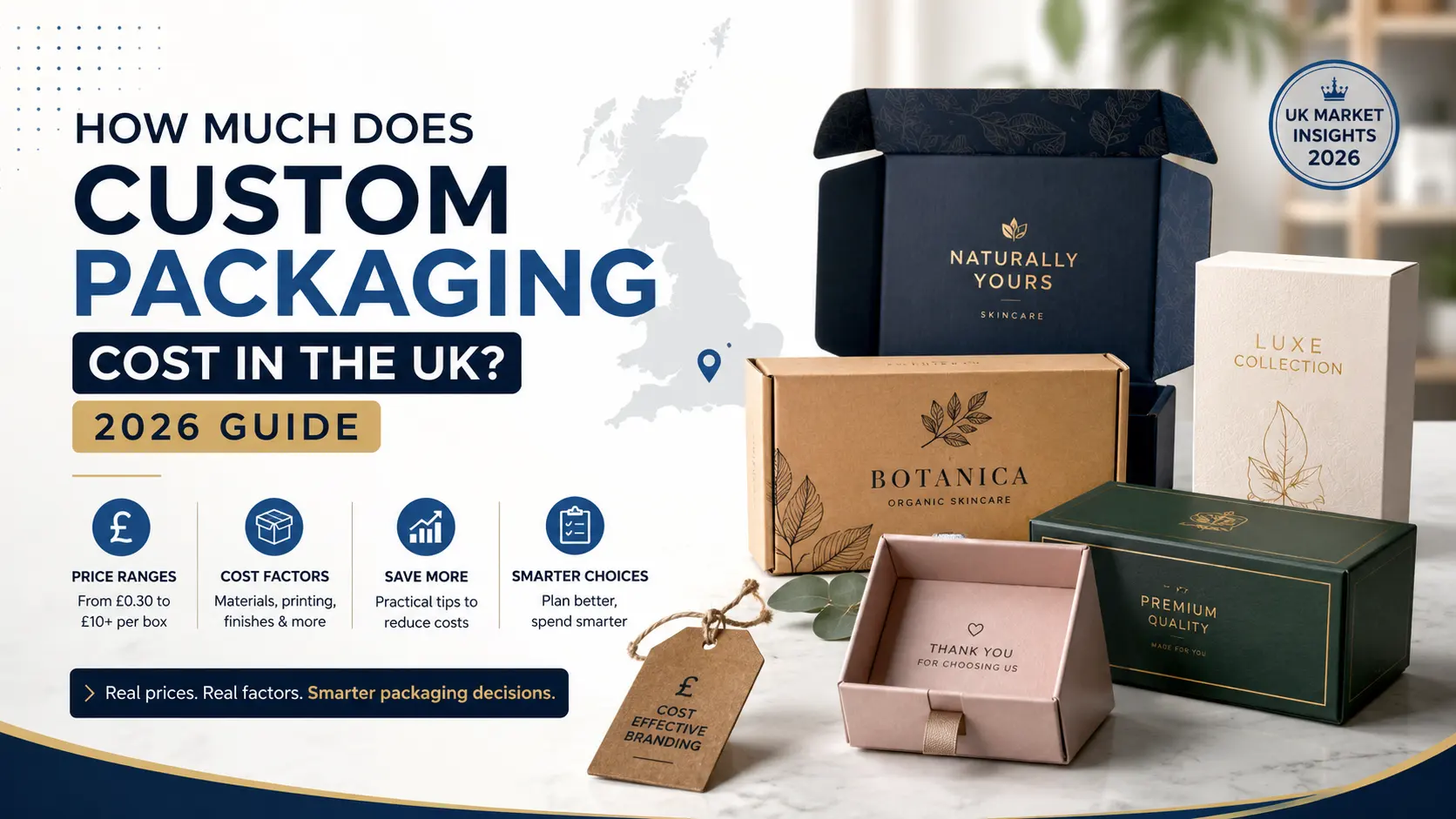
Custom packaging can make a product look more professional, protect it during delivery, and give customers a better buying experience. But before choosing a box style or finish, most businesses ask the same question: how much does custom packaging cost in the UK?
There is no fixed price that applies to every order. A small printed carton for a lightweight product may cost less than £1 per box in a suitable production run. A large mailer, protective insert, or luxury rigid box can cost several pounds per unit.
The final custom packaging cost depends on the box size, material, printing, quantity, finish, inserts, and delivery requirements. Understanding these factors helps you control costs without choosing packaging that looks cheap or fails to protect the product.
How Much Does Custom Packaging Cost?
As a broad UK planning estimate, custom packaging may fall within these price bands:
| Packaging level | Typical planning cost per box |
| Basic custom or lightly printed packaging | £0.30–£1.50 |
| Standard printed packaging | £1.50–£4.00 |
| Premium or luxury packaging | £4.00–£10.00+ |
These figures are broad market estimates rather than fixed supplier prices. The same box could cost £4 in a small order and considerably less per unit when ordered in a larger quantity. Size, board thickness, print coverage, and finishing can also move a box into a higher price band.
A more useful calculation is:
Total packaging cost ÷ number of usable boxes = real cost per box
The word “usable” matters. If boxes are damaged, difficult to assemble, too large for the product, or no longer match your branding, the lowest quoted price may not be the cheapest final option.
Why Custom Box Prices Vary So Much
Custom boxes are made to specific requirements. Even a small order may involve:
- Reviewing product dimensions
- Choosing a suitable box structure
- Creating or checking a dieline
- Preparing artwork
- Producing a digital or physical proof
- Setting up printing
- Cutting and folding the board
- Checking print and construction quality
- Packing and delivering the finished order
Much of this work is required whether you order 100 boxes or 1,000. With a larger order, the setup cost is spread across more units, which normally lowers the custom packaging price per box.
Main Factors Affecting Packaging Cost
1. Box Style
The construction of the box is one of the biggest factors in pricing.
A simple folding carton usually requires less material and assembly work than a rigid presentation box. A corrugated mailer may cost more than a small carton because it uses thicker board and has a more complex structure.
Common options include:
| Box style |
Typical use |
General cost level |
| Folding cartons | Cosmetics, food, supplements, and retail products | Low to medium |
| Corrugated shipping boxes | Ecommerce and delivery | Low to medium |
| Mailer boxes | Subscription products, clothing, and online orders | Medium |
| Sleeve boxes | Food, cosmetics, and retail presentation | Medium |
| Display boxes | Counter and shelf displays | Medium |
| Rigid boxes | Jewellery, gifts, and luxury products | High |
| Magnetic closure boxes | Corporate gifts and premium products | High |
The best choice is not always the most expensive structure. It is the box that gives the product enough protection while meeting the presentation standard customers expect.
2. Box Dimensions
Larger boxes use more board, take up more production space, and may cost more to store and transport.
Poor sizing creates costs in several ways:
- More material is used than necessary.
- Extra void fill may be needed.
- Fewer boxes fit into a delivery carton.
- Storage space is wasted.
- Products may move and become damaged.
- Parcel delivery costs may increase.
Measure the product at its widest, longest, and highest points. Include any bottles, lids, handles, protective wrapping, or accessories that must fit inside.
A small amount of clearance is useful. Too much empty space is normally wasteful.
3. Material and Board Thickness
The material must match the product’s weight, fragility, storage conditions and delivery journey.
Common materials include:
Paperboard
Suitable for lightweight retail products such as cosmetics, soap, supplements, and small food items. It prints well and can be folded into many carton styles.
Kraft board
Often chosen for a natural appearance. It can work well for food, handmade products, gifts, and brands that prefer a simple presentation.
Corrugated board
Contains a fluted layer between liner sheets. It provides more cushioning and strength than standard paperboard, making it suitable for ecommerce, mailers, and shipping boxes.
Rigid board
Thicker and more solid than folding carton board. It is commonly used for gift boxes, jewellery packaging, and premium products.
Choosing a heavier board than the product needs can increase the cost without adding meaningful protection. Choosing a board that is too weak can lead to crushed boxes, returns, and unhappy customers.
4. Order Quantity
Quantity has a direct effect on the cost of custom boxes.
A small order has a higher unit cost because the supplier must spread preparation and production work across fewer boxes. The unit price generally improves as the order quantity rises.
|
Order approach |
Main benefit |
Main risk |
| Small test order | Lower commitment and easier design testing | Higher price per box |
| Medium production run | Better balance between price and stock level | Requires storage and sales planning |
| Large bulk order | Lower unit cost | Money may be tied up in unused packaging |
Ordering 2,000 boxes simply because they cost less per unit is not always a saving. Packaging can become unusable when a product size, ingredient list, legal statement, barcode, or brand design changes.
A new business may be better starting with 100 or 250 boxes. An established product with stable monthly sales may gain more value from a larger run.
Some suppliers allow very low quantities, while others begin at 250, 500, or more. OneStep CustomBoxes currently states that orders can start from 100 boxes, allowing growing UK businesses to test custom packaging before moving to higher volumes.
Does Bulk Packaging Reduce Cost?
Yes, ordering custom packaging in bulk normally reduces the price per box. However, the savings only work when the boxes are likely to be used.
Before increasing an order, check:
- Average monthly product sales
- Seasonal demand
- Available storage space
- Planned product changes
- Possible branding updates
- Cash flow
- Risk of packaging becoming damaged in storage
Suppose a business uses 300 boxes per month. Ordering 1,000 boxes may provide a practical balance between unit price and stock level. Ordering 10,000 may produce a lower unit price, but it could also tie up cash and require a large, dry storage area.
The right quantity is based on total business cost, not only the number shown beside each box on a quotation.
5. Printing Method and Coverage
Printing only a logo on one outer panel normally costs less than printing detailed artwork across every side.
Pricing can change based on:
- One-colour or full-colour printing
- Outside-only printing
- Printing inside and outside
- Exact Pantone colour matching
- Large solid-colour areas
- Photographic images
- Food, safety, or product information
- Different artwork for each product variation
Digital printing can suit smaller runs and designs that change regularly. Other production methods can become more cost-effective at higher quantities, particularly when colour and design remain consistent.
Inside printing can create a stronger unboxing moment, but it should have a clear purpose. A simple message or brand pattern may provide more value than covering every internal panel with ink.
6. Finishes and Special Effects
Finishes can make branded packaging look more refined, but every added process may affect the price.
Common options include:
- Matte or gloss lamination
- Spot UV
- Foil stamping
- Embossing
- Debossing
- Soft-touch coating
- Window cut-outs
- Metallic details
- Textured paper
- Custom ribbons or closures
A beauty brand may benefit from foil on the logo rather than across the whole box. A food business may need a practical grease-resistant surface instead of a decorative finish.
Use premium effects where customers will notice them. Adding several finishes without a clear visual plan can raise the printed packaging cost while making the design feel busy.
7. Packaging Inserts
Inserts stop products from moving and improve presentation.
They can be made from:
- Folded card
- Corrugated board
- Moulded pulp
- Foam
- Paper padding
- Die-cut dividers
A custom insert adds to production cost, but it may reduce the need for bubble wrap, loose fill, or manual packing. It can also lower the risk of glass jars, bottles, and delicate items arriving damaged.
Compare the cost of packaging inserts with the cost of returns, replacements, and staff packing time. A slightly more expensive insert may reduce the overall fulfilment cost.
8. Artwork, Samples, and Tooling
Ask what the quoted price includes before comparing suppliers.
Possible setup costs include:
- Dieline creation
- Artwork adjustments
- Printing plates
- Cutting dies
- Digital proofs
- Physical samples
- Colour matching
- Prototype production
Some suppliers charge for these services separately. Others include some or all of them in the order.
OneStep CustomBoxes states that it provides free design assistance and does not apply die and plate charges. These inclusions can reduce the initial setup cost, particularly for smaller businesses ordering custom packaging for the first time.
9. Production Time
Urgent production often limits the available manufacturing options and may increase the price.
Businesses can control rush costs by planning around:
- Product launch dates
- Seasonal campaigns
- Christmas demand
- Retail delivery deadlines
- Existing packaging stock
- Artwork approval time
- Sample and testing time
Packaging should normally be ordered before the remaining stock reaches a critical level. Delaying approval until the final week can result in rushed decisions, higher delivery costs, or the temporary use of plain boxes.
10. Delivery, VAT and Quote Inclusions
Two quotations with similar unit prices may have very different final totals.
Check whether the price includes:
- Delivery to your UK address
- VAT
- Design support
- Dieline preparation
- Printing plates
- Cutting tools
- Proofs or samples
- Packing
- Pallets
- Split delivery
- Storage
- Import duties, where relevant
A box quoted at £1.20 plus setup, delivery, and VAT may cost more overall than a box quoted at £1.45 with those services included.
OneStep CustomBoxes publishes free shipping across the UK as part of its service, so businesses can compare the production price without adding a separate domestic delivery charge.
Costs Often Missing From Packaging Quotes
The supplier’s invoice is only one part of your packaging spend.
Assembly Time
Some box styles arrive flat and need to be folded, locked, or taped. A box that takes two minutes to assemble can create a large labour cost when hundreds of orders are packed each day.
Ask for an assembled sample and let the packing team test it.
Storage
Large orders need a clean, dry space. Flat folding cartons usually require less room than assembled rigid boxes.
Before ordering in bulk, calculate:
- Number of pallets or cartons
- Storage period
- Warehouse cost
- Risk of moisture
- Risk of crushing
- Ease of stock rotation
Damage and Returns
Weak packaging may create savings at the ordering stage, but losses after dispatch.
The real cost of a damaged delivery may include:
- Replacement product
- Second delivery
- Customer service time
- Refund processing
- Lost customer trust
- Negative reviews
Packaging should be tested using the actual product, insert, and delivery method.
Old or Unusable Stock
Product information can change. Packaging may also become outdated after a rebrand, regulatory update, or new product size.
Avoid printing several years of stock when the information on the box is likely to change.
UK Packaging Responsibility Costs in 2026
Packaging compliance is not always included in a box supplier’s quotation.
Under the UK’s Extended Producer Responsibility system, some organisations that supply or import packaging may need to record packaging data, register and pay relevant fees. The obligations depend on the business’s activities, turnover and the amount of packaging it handles. From the 2026–27 scheme year, fee modulation is also intended to make less recyclable packaging more expensive than packaging with better recyclability ratings.
Businesses that may fall within these rules should check current government guidance or speak with a qualified compliance adviser. Packaging design decisions such as unnecessary layers, mixed materials, and difficult-to-separate components may affect more than the initial box price.
How to Reduce Custom Packaging Costs
1. Right-Size the Box
Reduce unused space without making the fit too tight. Accurate dimensions can lower material use, void fill, and storage needs.
2. Start With One Strong Design
Using different artwork for every product variation can increase setup and stock complexity. A shared branded design with labels or sleeves may work better for small product ranges.
3. Use Finishes Selectively
Apply foil, embossing, or spot UV to the areas that customers notice most, such as the logo or product name.
4. Compare More Than Unit Price
Compare the total quote, what is included, material quality, delivery, turnaround, and support.
5. Test Before Ordering in Bulk
Order a sample or a smaller run. Check the product fit, colour, strength, assembly, and customer opening experience.
6. Plan Orders Around Real Sales
Use recent sales figures to estimate how many boxes you can use before the design or product changes.
7. Simplify the Box Structure
A simpler box can still look professional when the dimensions, print, and material are chosen carefully.
8. Reduce Packing Materials
A better-sized box or card insert may reduce tape, bubble wrap, and loose fill.
9. Prepare Accurate Quote Information
Suppliers can quote more accurately when they receive complete specifications. Missing details often lead to assumptions, revised prices, and delays.
What to Send When Requesting a Quote
Provide the following information:
- Product dimensions
- Product weight
- Required internal box dimensions
- Preferred box style
- Material or strength requirements
- Order quantity
- Number of artwork versions
- Outside or inside printing
- Required finishes
- Insert requirements
- Delivery postcode
- Required delivery date
- Existing artwork or logo files
- Photos of the product
- Current packaging problems
When you are unsure about the structure or material, explain how the box will be used. A supplier can make a better recommendation when they know whether the product will sit on a retail shelf, travel through a courier network, or be handed directly to a customer.
How to Compare Custom Packaging Quotes
| Check | Why it matters |
| Price per box | Helps compare unit cost at the same quantity |
| Total order price | Shows the actual spending commitment |
| Material specification | Prevents comparison between different board qualities |
| Internal dimensions | Confirms that the product will fit |
| Printing coverage | Clarifies what areas will be printed |
| Finishes | Identifies added decorative costs |
| Setup charges | Reveals tooling, plate, and artwork fees |
| Delivery | Prevents unexpected transport charges |
| Production time | Confirms whether the order meets your deadline |
| Samples and proofing | Reduces the risk of production errors |
| Reorder price | Helps with future packaging planning |
Make sure every supplier is quoting the same box size, material, quantity, and printing specification. Otherwise, the prices cannot be compared fairly.
Is Custom Packaging Worth the Cost?
Custom packaging is normally worth considering when it solves a clear business problem.
It can provide value when:
- Plain packaging makes the product look unfinished.
- Products are being damaged during delivery.
- The business wants a consistent brand appearance.
- Customers often share unboxing content.
- Products need to stand out on retail shelves.
- The packaging must hold several items together.
- Staff spends too much time using tape and protective fill.
- Premium products need a stronger presentation.
- A better fit could reduce wasted space.
Not every product needs a rigid box, foil logo, and custom foam insert. Many businesses achieve strong results with a well-sized carton, clear printing, and one carefully chosen finish.
The aim is not to buy the cheapest or most decorated box. It is to find packaging that gives the right balance of protection, presentation, packing speed, and unit cost.
Get an Accurate Custom Packaging Price
A useful quotation should be based on your actual product rather than a generic box price.
OneStep CustomBoxes supplies Custom packaging for UK businesses across retail, ecommerce, food, beauty, healthcare, and other sectors. Orders currently start from 100 boxes, with free design support, no die and plate charges, and free UK shipping listed among the available service benefits.
Send your product dimensions, required quantity, preferred box style, and artwork to receive a custom quote. When the structure is still undecided, share the product details and explain how it will be stored, displayed, or delivered.
Frequently Asked Questions
What is the average custom packaging cost in the UK?
Basic custom packaging may start from around £0.30 to £1.50 per unit, while standard printed packaging may cost roughly £1.50 to £4. Premium and luxury boxes can cost £4 to £10 or more. The actual price depends heavily on quantity, size, material, and finish.
Why is custom packaging expensive in small quantities?
Small orders still require artwork checking, proofing, machine setup, cutting, and quality control. These preparation costs are spread across fewer boxes, so the price per unit is higher.
What is the minimum order for custom packaging?
The minimum order differs between suppliers and packaging types. Some may require 250, 500, or more units. OneStep CustomBoxes currently lists a starting quantity of 100 boxes.
Does bulk packaging reduce cost?
Bulk ordering normally reduces the unit price because setup costs are divided across more boxes. It only saves money when the business can use and store the full order without the packaging becoming outdated.
How much do printed boxes cost?
The cost of printed boxes depends on box size, board type, print coverage, colour requirements, quantity, and finish. Printing a small logo on one panel generally costs less than full-colour artwork inside and outside the box.
Are packaging inserts expensive?
Simple folded-card inserts can be relatively economical. Foam, moulded or complex die-cut inserts cost more. The added cost may be worthwhile when an insert reduces product movement, damage, and packing time.
Can a small business afford custom packaging?
Yes. Small businesses can manage packaging costs by using lower minimum quantities, simple structures, limited print coverage, and carefully chosen finishes. Starting with a small run also reduces the risk of holding outdated stock.
How can I get an accurate custom box price?
Provide the product dimensions, weight, box style, material, quantity, printing requirements, finishes, inserts, delivery location, and deadline. A complete brief reduces assumptions and makes the quotation more accurate.