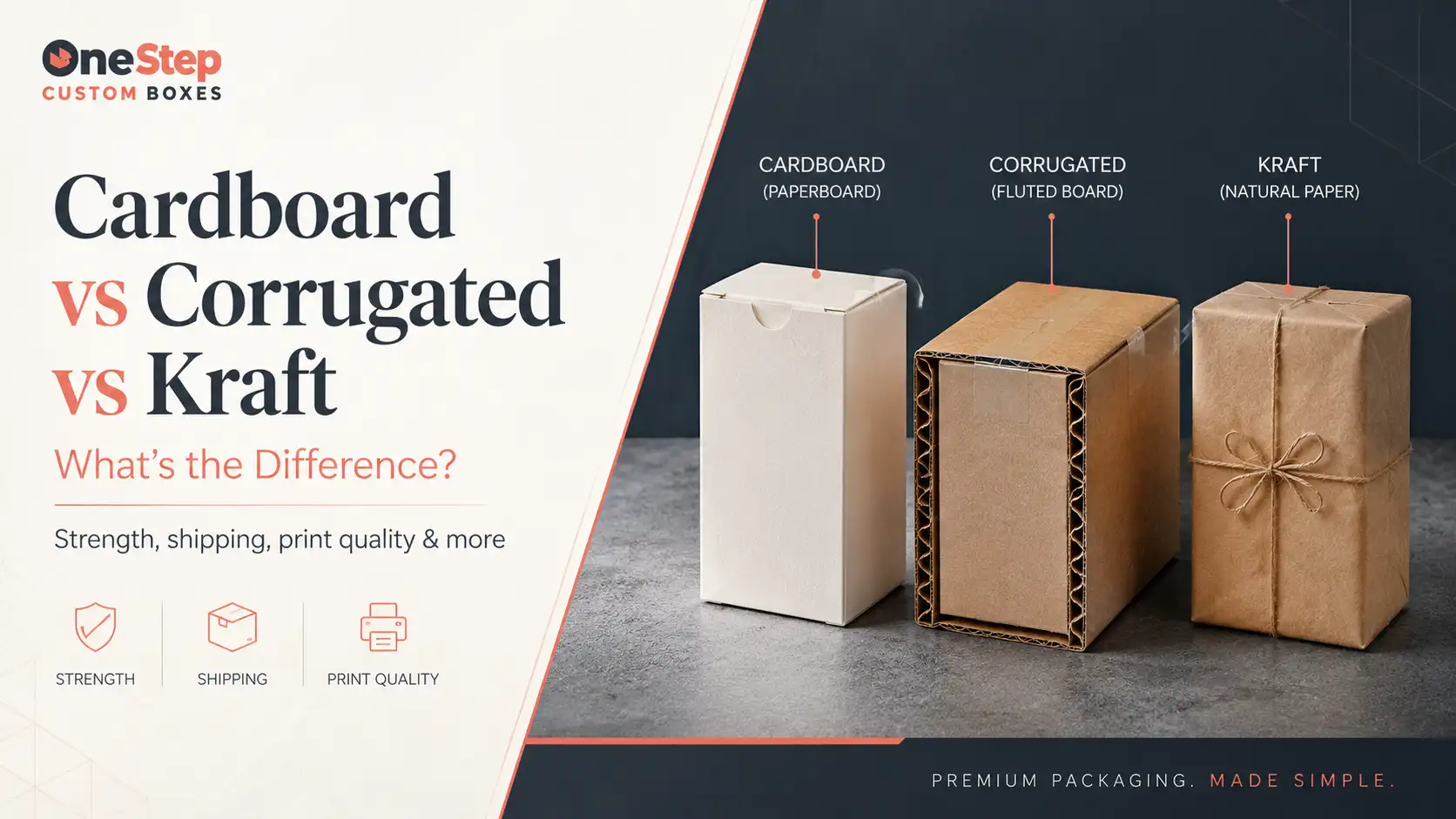
Choosing packaging sounds simple until a supplier asks whether you need cardboard, corrugated board, or kraft material. These terms are often used as though they mean the same thing, but they describe different materials and structures.
The cardboard vs corrugated decision affects product protection, printing quality, storage space, shipping costs and customer experience. Kraft adds another layer of confusion because it can describe paper, a natural brown appearance, or the liner used on a corrugated box.
For most retail cartons, lightweight paperboard works well. Products travelling through courier networks usually need corrugated packaging. Kraft is useful when a brand wants a natural finish, strong paper fibres or a simple recyclable presentation.
Cardboard, Corrugated and Kraft at a Glance
| Material | What it is | Best suited for | Main advantage | Main limitation |
| Cardboard or paperboard | A solid, flat sheet made from compressed paper fibres | Retail cartons, cosmetics, food sleeves, medicine boxes and lightweight products | Smooth printing surface and compact design | Limited cushioning for shipping |
| Corrugated board | Fluted paper placed between flat liner sheets | Mailer boxes, shipping cartons, ecommerce orders and fragile products | Better impact protection and rigidity | Takes more space than thin paperboard |
| Kraft paper or kraft board | Strong paper usually recognised by its natural brown appearance | Eco-style retail packaging, bags, wraps and corrugated liners | Natural presentation and good tear resistance | Strength varies by thickness and construction |
The most important point is that kraft and corrugated are not opposites. A corrugated box can have kraft liners, white liners, recycled test liners or a mixture of these materials.
What Is Cardboard?
“Cardboard” is a broad everyday term rather than one precise packaging grade. People may use it to describe cereal boxes, postal cartons, rigid gift boxes and corrugated shipping cases.
In professional packaging, thin solid material is more accurately called paperboard or cartonboard. It is made by pressing paper fibres into a smooth sheet without an internal fluted layer.
Common paperboard packaging includes:
- Folding cartons for cosmetics
- Pharmaceutical cartons
- Chocolate and confectionery boxes
- Soap packaging
- Small electronics cartons
- Food sleeves
- Product inserts
- Lightweight retail boxes
Paperboard can be cut, folded and printed with detailed artwork. Its smooth surface works well for fine text, brand colours, product instructions and premium finishes.
It is also supplied in different thicknesses and grades. A thicker sheet can feel firm and premium, but thickness alone does not turn paperboard into corrugated board.
Paperboard vs Cardboard
Paperboard is a specific solid paper-based material. Cardboard is the general word many customers use for several kinds of paper packaging.
A supplier may therefore ask follow-up questions when someone requests a “cardboard box”. The correct choice depends on whether the box will sit on a shop shelf, hold a lightweight product, or travel through a delivery network.
What Is Corrugated Cardboard?
Corrugated board has a layered structure. A wavy inner sheet, known as fluting, is glued between flat sheets called liners. The arches created by the fluting give the board more rigidity and resistance than the separate paper layers could provide on their own.
A standard single-wall board normally contains:
- One outer liner
- One fluted medium
- One inner liner
The air spaces and curved flutes help absorb pressure, vibration and small impacts. That is why corrugated packaging is widely used for ecommerce deliveries, storage and product distribution.
Corrugated boxes can also be die-cut into mailer styles, product trays, postal cartons and fitted inserts. They do not have to look like basic brown shipping cases.
Corrugated vs Cardboard Boxes
The main difference between cardboard and corrugated boxes is their construction.
A paperboard carton is normally one solid sheet. A corrugated box contains a fluted layer that creates extra depth and protection.
Corrugated board is usually the safer option when:
- The product is fragile
- The box will be couriered
- Several boxes will be stacked
- The contents are moderately heavy
- The parcel may be handled several times
- Space needs to be reduced with a fitted box
- The outer packaging must resist crushing
Paperboard is often more suitable when the box mainly needs to present a lightweight product on a shelf.
What Is Kraft Packaging?
Kraft is a type of paper commonly associated with a natural brown colour. However, colour is not the full definition. Kraft paper is produced to retain strong fibres, giving it useful tear and tensile properties.
Kraft can appear in several packaging formats:
- Kraft wrapping paper
- Kraft paper bags
- Solid kraft paperboard cartons
- Kraft sleeves
- Kraft mailers
- Kraft liners on corrugated board
- Kraft food packaging made with suitable barriers
- Natural brown product inserts
Kraft packaging is popular with brands that want an understated, handmade or environmentally aware presentation. Black or dark-coloured printing can look especially clear against natural brown stock.
However, a brown box is not automatically made from virgin kraft fibre. Recycled liners can also have a brown appearance. Ask the supplier about the actual board grade, fibre composition and performance rather than choosing by colour alone.
Is Kraft Paper Stronger Than Cardboard?
Kraft paper is not automatically stronger than every kind of cardboard.
Strength depends on:
- Fibre quality
- Material thickness
- Grammage
- Number of layers
- Box construction
- Flute profile
- Moisture exposure
- Product weight
- Box dimensions
- Direction of pressure
A thin kraft sheet may have good tear resistance but will not protect a heavy glass product as well as a correctly specified corrugated box.
For shipping, corrugated board is normally stronger as a complete structure because the fluting provides rigidity and cushioning. For bags, wraps and lightweight cartons, kraft paper can offer a useful balance between strength, flexibility and appearance.
Kraft Paper vs Corrugated Cardboard
The right choice depends on what the packaging must do.
Choose kraft paper or solid kraft board when you need:
- A natural retail presentation
- Lightweight wrapping
- Product sleeves
- Paper bags
- Simple folding cartons
- Low-bulk packaging
- A surface suitable for minimal printed designs
Choose corrugated cardboard when you need:
- Courier protection
- Better resistance to crushing
- Structural support
- Space for protective inserts
- Stackable cartons
- Packaging for heavier products
- Mailer boxes that protect and present the product
A brand can also combine both benefits by using kraft-faced corrugated packaging. This creates a strong shipping structure with a natural outer appearance.
E Flute vs B Flute
Flute type affects box thickness, cushioning, print appearance, and storage requirements. Two common choices for custom packaging are E flute and B flute.
FEFCO’s indicative figures place E-flute height at around 1.2 mm and B-flute height at around 2.4 mm before the liner sheets are included. Exact finished thickness can vary with the paper grade and manufacturing specification.
| Factor | E flute | B flute |
| Profile | Fine and compact | Thicker and more substantial |
| Printing surface | Smoother surface for detailed designs | Good for standard branding and shipping marks |
| Storage | Uses less space when flat | Takes slightly more storage space |
| Cushioning | Suitable for smaller and lighter products | Better suited to products needing more protection |
| Common use | Retail mailers, cosmetics, subscription boxes and presentation packaging | Ecommerce cartons, shipping boxes and protective packaging |
| Appearance | Neater, slimmer profile | More visibly corrugated at cut edges |
When E Flute Makes Sense
E flute is useful when presentation matters almost as much as protection. Its finer profile produces a relatively smooth surface and a slimmer box.
It is commonly chosen for:
- Beauty products
- Small electronics
- Subscription boxes
- Gifts
- Jewellery
- Lightweight ecommerce products
- Premium printed mailers
A common mistake is choosing E flute only because it looks neater. A thin profile may not provide enough protection for a heavy or fragile product.
When B Flute Makes Sense
B flute provides a thicker structure and is often selected when a product needs more cushioning or resistance during distribution.
It can work well for:
- Multiple-item orders
- Homeware
- Bottled products with suitable inserts
- Clothing shipments
- Larger ecommerce parcels
- Food delivery boxes
- Products passing through several warehouses
The final choice should consider more than the flute letter. Paper weights, liner quality, box dimensions and internal support can change the performance of the finished box.
Single-Wall vs Double-Wall Cardboard
Single-wall corrugated board uses one fluted layer between two liners. Double-wall board normally uses two fluted layers separated by an additional liner. FEFCO also recognises triple-wall constructions for demanding applications.
Single-Wall Boxes
Single-wall board is suitable for many everyday ecommerce and retail deliveries.
Its benefits include:
- Lower material use
- Lighter parcel weight
- Easier handling
- Less warehouse space
- Lower cost than heavier constructions
- Good protection for many light and medium products
It is not automatically suitable for every courier parcel. A large single-wall box with empty space may collapse more easily than a smaller box designed to fit the product closely.
Double-Wall Boxes
Double-wall board provides more rigidity and protection. It is useful when products are heavy, fragile, or exposed to repeated handling.
Common applications include:
- Heavy equipment
- Multiple glass items
- Export packaging
- Large electronic products
- Industrial components
- Stacked warehouse shipments
- Products requiring extra puncture resistance
Double-wall packaging costs more and adds weight. Using it for every order can increase material, storage, and delivery costs without providing a meaningful benefit.
The better goal is not to choose the thickest board. It is to use the lightest specification that protects the product reliably.
Kraft Liner vs Test Liner
The liners are the flat sheets on the outside and inside of corrugated board. Their fibre content affects appearance, print performance and strength.
Kraft Liner
Kraft liner is generally produced mainly from primary wood fibres. It is often selected when stronger fibre performance, moisture tolerance or a consistent outer surface is needed.
It may be used on:
- Premium ecommerce boxes
- Packaging exposed to demanding handling
- Boxes requiring a strong outer facing
- Natural brown branded packaging
- Corrugated cases carrying heavier products
Test Liner
Test liner is generally produced mainly from recovered fibres. It is widely used in corrugated packaging and can provide a practical balance between cost, appearance and performance.
It may be suitable for:
- Standard shipping cartons
- Inner liners
- Everyday ecommerce packaging
- Cost-controlled packaging runs
- Boxes where extreme performance is unnecessary
A box can use kraft liner on one side and test liner on the other. This allows the specification to place performance where it matters instead of using the most expensive material throughout.
Which Material Is Best for Shipping?
Corrugated board is normally the best packaging material for shipping because its fluted construction provides cushioning and rigidity.
The right corrugated specification still depends on real shipping conditions.
Before ordering, consider:
- Product weight: A small but heavy product can place more stress on the box than a large lightweight item.
- Fragility: Glass, ceramics and electronics may require inserts as well as a stronger outer box.
- Space: Oversized boxes allow products to move and may collapse under stacking pressure.
- Courier handling: Parcels can be dropped, compressed, tipped and moved across several depots.
- Storage conditions: Humidity can weaken paper-based packaging.
- Stacking height: Bottom boxes carry more compression than boxes at the top.
- Return use: Resealable or double-tape mailers may be useful when customers often return products.
- Print requirements: Detailed graphics may affect the choice of liner, flute and printing method.
A well-fitted single-wall box can outperform a poorly sized double-wall box. Good packaging design uses the product dimensions, weight and delivery route together.
Choosing the Right Material for Different Products
Cosmetics and Skincare
Lightweight skincare tubes, soaps and makeup products often work well in printed paperboard cartons.
Glass jars or bottled products sold online may need:
- A corrugated mailer
- Fitted cardboard inserts
- Dividers between products
- Limited space
- Strong closures
- Clear handling of potential leakage
Clothing and Textiles
Clothing is not normally fragile, so lightweight corrugated mailers may provide enough protection. Kraft mailers can support a natural brand style, while white-lined boxes may produce brighter printed colours.
The packaging should resist compression without becoming unnecessarily heavy.
Food and Takeaway Products
The material must match the food, temperature, grease level and delivery time. Standard paper or corrugated board may require a suitable grease-resistant or moisture-resistant barrier.
Do not assume that every kraft or cardboard material is suitable for direct food contact. Confirm the intended use, material declaration, and relevant food-contact requirements with the supplier.
Glass and Fragile Products
Fragile items usually need more than a thicker outer box. Protection may also depend on:
- Die-cut inserts
- Corrugated dividers
- Corner supports
- Void reduction
- Separation between items
- Resistance to movement
- Drop-testing under realistic conditions
The box should hold the product firmly without placing harmful pressure on delicate parts.
Retail Products
Paperboard is often the better choice when the main priorities are shelf presentation, detailed printing and efficient use of space.
A separate corrugated transit case can then protect several retail cartons during distribution. This avoids making each product carton heavier than necessary.
Common Packaging Material Mistakes
Using “Cardboard” as the Full Specification
Requesting a cardboard box does not tell the supplier enough. Include the product dimensions, weight, use, quantity, and delivery method.
Choosing by Appearance Alone
A natural brown finish does not prove that a box is stronger, fully recycled or easily recyclable. Ask what the material is made from and how it performs.
Assuming Thicker Always Means Better
Extra thickness can increase storage, material and shipping costs. Board quality, flute direction and box design can matter as much as thickness.
Ignoring the Packed Weight
The product weight is only part of the load. Include inserts, leaflets, accessories and the box itself when considering total packed weight.
Ordering an Oversized Shipping Box
A larger box may appear safer, but excess space allows movement and requires more void fill. It can also increase delivery charges when carriers use parcel dimensions to calculate pricing.
Adding Too Many Finishes
Plastic windows, heavy lamination, glitter and difficult-to-separate components can affect recycling. Current UK recyclability guidance treats some double-sided laminations, waxed materials and other contaminated paper formats differently from simple paper and board packaging.
Is Cardboard Packaging Recyclable?
Many simple paperboard and corrugated formats can enter paper and card recycling streams when they are clean and free from problematic components. Paper and board are widely collected across UK local authorities, although local presentation rules can still vary.
Recyclability can be reduced by:
- Plastic layers
- Wax coatings
- Food or grease contamination
- Glitter
- Permanent foam inserts
- Difficult-to-remove windows
- Mixed-material handles
- Excess adhesive
- Wet or heavily damaged fibres
Corrugated packaging in the UK also contains a significant amount of recovered fibre. CPI has reported an industry average of around 75% recycled fibre, while explaining that fresh fibre remains necessary to maintain paper strength through repeated recycling cycles.
A good sustainability decision considers the whole packaging system:
- Is the box correctly sized?
- Does it prevent product damage?
- Can unnecessary void fill be removed?
- Can the customer separate different materials?
- Is the recycling instruction clear?
- Is a heavier box being used without a practical reason?
Preventing a product from breaking can be more valuable than saving a small amount of board and then having to manufacture and ship a replacement.
What to Tell Your Packaging Supplier
A clear brief helps the supplier recommend the right board without over-specifying the box.
Provide:
- Product length, width and height
- Packed product weight
- Number of items per box
- Whether the item is fragile
- Retail or shipping use
- Courier or pallet distribution
- Required box style
- Preferred colour
- Printing coverage
- Finish requirements
- Insert requirements
- Estimated order quantity
- Storage conditions
- Sustainability priorities
Ask for a physical sample when the product is heavy, fragile, or unusually shaped. A screen mock-up can confirm artwork placement, but it cannot show how the board feels or performs when packed.
Making the Final Choice
Choose paperboard for lightweight retail cartons with detailed printing.
Choose corrugated board for shipping, ecommerce orders, heavier goods and products needing cushioning.
Choose kraft paper or kraft board for wraps, bags, natural-looking cartons and packaging where tear resistance and a simple finish matter.
Choose kraft-faced corrugated board when you need shipping protection with a natural brown presentation.
Choose double-wall corrugated board when testing or real delivery conditions show that single-wall packaging does not provide enough strength.
OneStep CustomBoxes supplies custom paperboard, kraft and corrugated packaging for UK businesses, including ecommerce mailers, retail boxes and shipping cartons. Orders can be produced with custom dimensions, printing and finishes, with design support and digital artwork approval before production. The company currently advertises minimum orders starting from 100 boxes and delivery across the UK.
Request a custom quote with your product size, packed weight and delivery method to compare suitable board options before placing a full order.
Frequently Asked Questions
1. What is the main difference between cardboard and corrugated cardboard?
Standard paperboard is normally a solid sheet. Corrugated cardboard contains a fluted paper layer between flat liners. The fluting gives corrugated board more rigidity, cushioning, and protection.
2. Is corrugated cardboard better than normal cardboard?
Corrugated cardboard is usually better for shipping and heavier products. Paperboard is often better suited for lightweight retail cartons that require a smooth print surface and a compact shape.
3. Is kraft the same as cardboard?
No. Kraft describes a type of paper or liner, while cardboard is a broad term for paper-based board. Kraft paper can be used to make solid cartons, wraps, bags, or the outer liner of a corrugated box.
4. Can a corrugated box also be a kraft box?
Yes. Corrugated board can be made with natural kraft liners. The finished box has a fluted structure and a kraft outer surface.
5. Is E flute or B flute stronger?
B flute is thicker and is often selected when more cushioning or protection is needed. E flute is slimmer and provides a smoother surface for detailed printing. The total board grade and box design also affect strength.
6. Is single-wall cardboard suitable for ecommerce shipping?
Single-wall corrugated board is suitable for many light and medium ecommerce products. Heavy, fragile, or large products may need double-wall board, internal supports, or a stronger liner specification.
7. What is the difference between kraft liner and test liner?
Kraft liner is generally made mainly from primary fibres, while test liner is generally made mainly from recovered fibres. Both can be used in corrugated board, depending on the required performance, appearance and budget.
8. What is the most recyclable box material?
A simple, clean paperboard or corrugated box without difficult coatings or permanent mixed-material parts is usually easier to recycle. Local collection instructions and the exact packaging construction should still be checked.