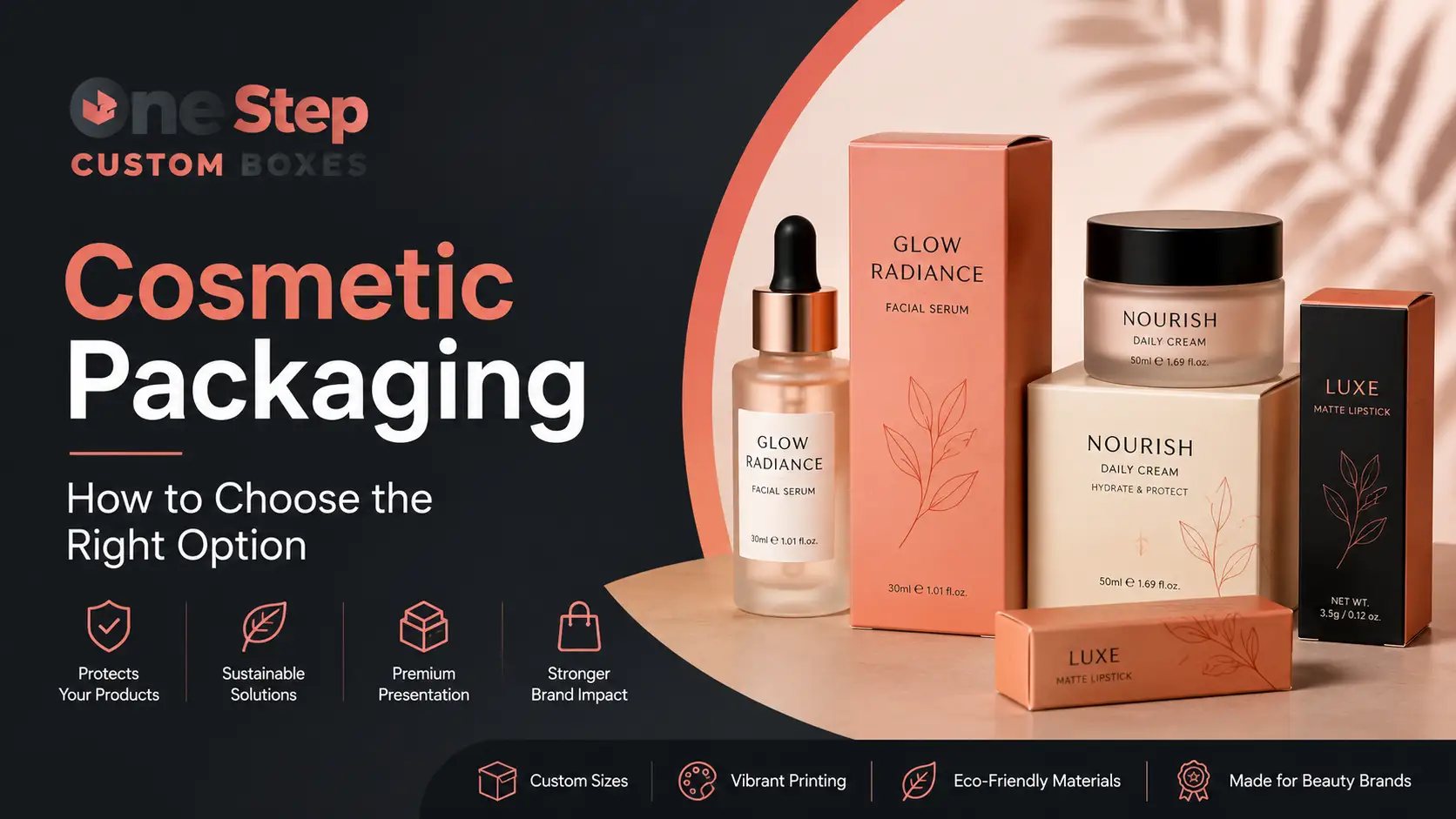
A beauty product can have an excellent formula and still struggle to earn attention if the packaging feels wrong. A serum bottle that moves around inside its box, a cream carton that crushes easily, or a premium product wrapped in cheap-looking packaging can reduce perceived value before the customer even tries what is inside.
Good Cosmetic packaging has several jobs at once. It protects the formula and container, gives customers important product information, supports your brand position, works through retail or ecommerce handling, and makes the product easier to recognise.
The right choice is rarely the most expensive option. It is the packaging that fits the product, sales channel, customer expectations, legal requirements, and budget without adding unnecessary materials.
Start With the Product, Not the Packaging Design
One of the most common mistakes in beauty packaging is choosing a box because it looks attractive before checking whether it works for the product.
Start with practical questions:
- Is the product a bottle, jar, tube, palette, compact or gift set?
- Is the primary container glass, plastic or metal?
- How heavy is it?
- Can it leak?
- Is the container fragile?
- Does the formula need protection from light or repeated air exposure?
- Will the product sit on a retail shelf or travel through a courier network?
- Does the packaging need enough space for regulatory information?
- Will customers expect a premium, clinical, natural or minimalist appearance?
A 30 ml glass serum, for example, has different packaging needs from a lightweight lip balm tube.
The serum may need a fitted carton and insert to restrict movement. The lip balm may only need a compact folding carton with good print quality.
Packaging should solve the product’s practical problems before it solves its visual ones.
Understand Primary and Secondary Cosmetic Packaging
Beauty packaging normally involves more than one layer.
Primary packaging
Primary packaging directly contains the cosmetic formula.
Examples include:
- Serum bottles
- Cream jars
- Lotion pumps
- Tubes
- Lipstick containers
- Compacts
- Airless dispensers
- Dropper bottles
The primary package needs to be compatible with the formulation.
For example, airless packaging for skincare can reduce repeated contact between the product and outside air during dispensing. Opaque or UV-protective Cosmetic packaging may also be considered for formulas that are sensitive to light.
Packaging compatibility should always be assessed against the actual formulation rather than assumed from appearance alone.
Secondary packaging
Secondary packaging sits around the primary container.
This includes:
- Folding cartons
- Printed cosmetic boxes
- Sleeves
- Rigid-style presentation boxes
- Gift boxes
- Inserts and dividers
- Multipack boxes
Secondary packaging is where beauty brands have more freedom to combine protection, branding, product information, and the unboxing experience.
For a UK skincare brand, a well-sized printed carton around a serum bottle may provide a cleaner retail presentation while creating space for branding and required information.
OneStep CustomBoxes offers Custom cosmetic boxes in formats including folding cartons, sleeves, tuck-end structures, rigid-style boxes, inserts, and custom-sized packaging for products such as serums, creams, lipsticks, oils, and beauty sets.
Which Types of Cosmetic Packaging Work Best?
There is no single best packaging format for every beauty product.
| Packaging type | Best suited for | Main benefit | Main consideration |
| Folding carton | Serums, creams, lipstick, tubes | Lightweight and highly printable | Limited impact protection on its own |
| Rigid-style box | Luxury sets, fragrance and gifts | Premium presentation | Higher material and production cost |
| Kraft carton | Natural and minimalist brands | Simple, tactile presentation | Colours can print differently on brown stock |
| Sleeve packaging | Sets, trays and premium products | Adds branding without a full new box | Usually needs another structure underneath |
| Corrugated mailer | Ecommerce beauty orders | Better transport protection | Larger than a normal retail carton |
| Inserted box | Glass bottles, jars and sets | Holds products in position | Insert design must match the exact product |
| Airless primary pack | Serums, creams and active skincare | Limits repeated air exposure during dispensing | Compatibility and dispensing performance need testing |
A product may also use several formats together.
For example:
Glass serum bottle → fitted folding carton → protective ecommerce mailer
Trying to make one small Retail box perform every shipping function can lead to damage. Likewise, putting every retail carton inside an oversized shipping box creates unnecessary material and postage volume.
What Is the Best Material for Cosmetic Packaging?
The best material for cosmetic packaging depends on what the packaging must do.
Paperboard and cardboard
Paperboard works particularly well for secondary cosmetic packaging because it offers a smooth printing surface, folds efficiently, and can be produced around precise product dimensions.
It is commonly suitable for:
- Skincare cartons
- Makeup boxes
- Lipstick boxes
- Serum packaging
- Cream boxes
- Retail beauty products
For heavier or highly fragile products, the board grade, construction, and internal support matter as much as the outer design.
Kraft board
Kraft packaging suits brands that want a natural, understated appearance.
It works particularly well when the visual identity uses:
- Simple typography
- Limited colour printing
- Natural textures
- Earth-toned branding
- Minimalist cosmetic packaging
Remember that printing onto brown kraft will not reproduce colours in the same way as bright white board.
Rigid board
Rigid-style packaging makes more sense when presentation value justifies additional material and cost.
Typical uses include:
- Beauty gift sets
- Influencer launch kits
- High-value skincare
- Fragrance collections
- Luxury limited editions
Do not choose rigid packaging simply because the product is positioned as premium. Strong paperboard with careful structural design, embossing or restrained foil details can also create a premium result with less bulk.
Sustainable Cosmetic Packaging Needs More Than a Green Colour
Putting leaves on a box does not make it sustainable.
Better Sustainable cosmetic packaging starts with structural decisions.
Consider:
- Can the amount of material be reduced?
- Is the box appropriately sized?
- Can unnecessary plastic components be removed?
- Can the customer easily understand how to dispose of it?
- Are several materials permanently bonded together?
- Is recycled content suitable for the application?
- Can the package be reused or refilled realistically?
Recyclable cosmetic packaging
A straightforward paper-based box may sometimes be a better environmental choice than a complicated pack made from several difficult-to-separate materials.
Where practical, simplify the construction.
Mono-material packaging can make end-of-life handling simpler because fewer material types need to be separated.
Post-consumer recycled packaging
Post-consumer recycled, or PCR, material uses material recovered after consumer use.
PCR content can reduce dependence on virgin material, but there may be trade-offs in appearance, colour consistency, clarity or surface finish depending on the material and percentage used.
For luxury brands, that does not automatically make PCR unsuitable. It simply means the packaging specification should be tested against the desired finish.
FSC-certified cosmetic packaging
For paper-based packaging, brands may also look for FSC-certified material when responsible forest sourcing is part of their packaging policy.
Do not use an FSC claim or logo simply because a box contains paper. Confirm the relevant certification and usage requirements with the supplier before printing environmental claims onto packaging.
Plastic-free cosmetic packaging
Plastic-free cosmetic packaging is easier to achieve with some secondary boxes than with primary beauty containers.
A cardboard carton can often avoid:
- Plastic windows
- Plastic inserts
- Foam
- Plastic lamination
- Plastic void fill
But removing plastic should not make the pack so weak that products arrive damaged.
Sustainability has to work through the complete product journey.
Refillable Packaging Is Growing, but Convenience Matters
Refillable beauty systems remain an important packaging direction in 2026. Recent industry activity includes reusable skincare bottles with replacement cartridges and refillable systems across skincare, cosmetics and personal care.
But a refill system is not automatically successful because it reduces the amount of packaging used in the refill.
Customers must actually use it repeatedly.
Cost, convenience and availability continue to affect refill adoption in beauty, even as major brands expand their refillable ranges.
For brands considering refillable cosmetic packaging, ask:
- How easy is the refill to insert?
- Will customers understand the process immediately?
- Is the refill cheaper or more convenient than buying another complete pack?
- Is the permanent outer container durable enough for repeated use?
- Can the refill itself be disposed of responsibly?
- Will repeat customers be able to buy refills easily?
A refill concept that creates friction may look sustainable in a presentation but fail in normal customer use.
Cosmetic Packaging Trends in 2026 Favour Simpler, Smarter Systems
Several ideas are shaping beauty packaging decisions in 2026.
1. Refillable formats
Refills continue to appear across skincare and other beauty categories, but practical usability is becoming as important as the environmental message.
2. Mono-material thinking
Reducing unnecessary combinations of materials can make packaging simpler to separate and manage at end of life.
3. Minimalist cosmetic packaging
Premium packaging does not always need heavy graphics.
Clean typography, strong spacing, controlled colour palettes, embossing and tactile materials can create a premium appearance without filling every panel with design elements.
4. Packaging designed around reuse
Some 2026 beauty packaging developments combine reusable or refillable formats with materials and structures designed for a longer useful life.
5. Clearer communication
Beauty customers need to understand the product quickly.
A beautiful front panel that hides the product type, shade, size or key use can create confusion rather than desire.
The strongest cosmetic packaging design balances brand personality with information hierarchy.
Luxury Cosmetic Packaging Should Feel Intentional, Not Excessive
Luxury packaging is often confused with adding more.
More foil. More layers. More board. More decoration.
That can increase cost without improving the customer experience.
Better luxury cosmetic packaging ideas focus on controlled details.
Consider:
- Precise box dimensions
- Strong board with a clean structure
- One carefully placed foil element
- Embossed or debossed branding
- Matte surfaces
- Custom inserts
- Consistent typography
- Controlled use of colour
- A deliberate opening experience
OneStep CustomBoxes currently lists cosmetic packaging options including matte and gloss finishes, foil stamping, embossing, debossing, inserts and custom structures.
A premium serum does not necessarily need a huge box. Often, a compact carton with an excellent fit and restrained finish feels more considered.
Skincare Packaging Should Match the Formula and Routine
Good packaging for skincare products also considers how the customer actually uses the formula.
A night cream may sit in a bathroom for months. A facial serum may be used twice every day. A travel moisturiser may spend most of its life inside a handbag.
Useful skincare packaging ideas therefore depend on real usage.
For example:
- Use secure closures where leakage is a concern.
- Consider light protection for light-sensitive formulations.
- Consider dispensing systems that reduce repeated product exposure where appropriate.
- Give fragile glass containers sufficient secondary protection.
- Make dosage and directions easy to find.
- Avoid boxes that are difficult to open with wet hands if the product is commonly used around a sink.
- Keep important text readable rather than shrinking it to preserve an overly minimal design.
Packaging is successful when it works at the customer’s dressing table as well as it does in a product photograph.
UK Cosmetic Packaging Regulations Must Be Considered Before Artwork Approval
Designing the carton first and trying to squeeze regulatory text into the remaining space later is a costly mistake.
For cosmetic products made available to consumers in Great Britain, current GOV.UK guidance requires applicable labelling information such as the Responsible Person’s name and address, country of origin for imported products, nominal quantity, durability or Period After Opening information, precautions, batch identification, product function where necessary and ingredients.
The information must also meet rules on where and how it is presented. Ingredient information may, in specified situations, appear on packaging or associated information where space creates practical difficulty.
The Responsible Person matters
Cosmetics placed on the Great Britain market require a Responsible Person who is responsible for meeting relevant safety and compliance obligations. Current GB guidance states that the Responsible Person must be established in the UK.
There is an important transitional labelling point for brands operating in 2026: current government technical guidance provides transitional arrangements until 31 December 2027 for certain Responsible Person name, address and country-of-origin labelling requirements where the EU-law conditions described by the guidance are met.
Northern Ireland follows a different regulatory framework, so a brand selling across both GB and NI should not assume that one compliance workflow automatically applies in the same way to both markets.
INCI cosmetic labelling
Ingredient information is another area where artwork space matters.
GB guidance requires a full ingredient list and provides rules for ingredient naming and ordering. Nanomaterial ingredients must be identified accordingly, including “(nano)” after the relevant ingredient name.
For packaging planning, the practical lesson is simple:
Approve compliance copy before locking the final box layout.
Your packaging printer can produce the artwork supplied, but responsibility for cosmetic regulatory compliance sits with the relevant business and Responsible Person, not simply with the company printing the carton.
Cosmetic Packaging for Small Businesses Should Control Risk
Small beauty brands often face a different problem from established companies.
Cash is tied up in:
- Formula production
- Testing
- Product photography
- Ecommerce setup
- Marketing
- Packaging
- Inventory
Ordering overly complex packaging too early can create unnecessary pressure.
Better cosmetic packaging for a small business usually starts with flexibility.
Prioritise:
- A box that fits correctly.
- Good print quality.
- Enough space for required information.
- A material suitable for the product.
- Brand consistency.
- A realistic order quantity.
- Easy repeat ordering.
Special finishes can be added when they contribute something useful.
A new skincare brand may get more value from a precise custom-size carton and insert than from several decorative finishes applied to an oversized box.
Before a larger production order, testing a physical sample can help uncover fitting, print, structure and finish problems. OneStep CustomBoxes recommends checking samples for factors such as product fit, box feel, print quality and finish before bulk production.
How to Package Cosmetics for Shipping
Retail packaging and Shipping packaging solve different problems.
A folding carton may look excellent on a shelf but still needs protection when travelling through ecommerce networks.
For fragile cosmetics, consider a layered approach.
Step 1: Secure the primary container
Make sure lids, pumps, droppers and caps are properly closed.
Where leakage is possible, assess whether additional containment is required.
Step 2: Prevent movement inside the product box
Use a correctly sized carton or fitted insert.
A glass bottle repeatedly hitting the walls of an oversized carton has a greater chance of becoming damaged.
Step 3: Protect the retail box
Place the cosmetic carton inside shipping packaging suited to the product’s weight and fragility.
Corrugated packaging is generally more suitable for courier protection than lightweight retail paperboard. OneStep CustomBoxes similarly distinguishes lightweight retail cartons from corrugated structures used where greater transport protection is required.
Step 4: Reduce space
Too much void space allows products to move.
It can also increase packaging volume and courier costs.
Step 5: Test the complete packed order
Do not test only the cosmetic carton.
Test the product, insert, retail carton, and shipping box as one system.
A packaging setup that looks perfect on a desk may behave differently after stacking, vibration, and courier handling.
Common Cosmetic Packaging Mistakes
A few errors repeatedly create unnecessary cost.
Choosing design before dimensions
Even a small sizing error can leave a product loose or make assembly difficult.
Using one box for every product size
A family look is useful, but forcing different bottles and jars into the same dimensions can waste material and reduce protection.
Adding too many premium finishes
Foil, lamination, embossing and special coatings can all work well. Using all of them together rarely guarantees a better result.
Treating “eco-friendly” as a design style
Brown kraft, green ink and recycling symbols do not prove environmental performance.
Use specific material and disposal information instead of vague sustainability language.
Forgetting ecommerce conditions
A retail-ready carton is not automatically courier-ready.
Leaving compliance text until the end
Artwork becomes crowded when required information is added after the design has already been approved.
Ignoring repeat production
A packaging concept should still be practical when the brand moves from its first launch to larger repeat orders.
A Simple Checklist for Choosing Cosmetic Packaging
Before approving your next beauty packaging order, check:
- Product fit: Does the box match the exact container?
- Protection: Can the product move, leak or break?
- Formula needs: Does the primary pack suit the formulation?
- Sales channel: Retail, ecommerce, wholesale or all three?
- Material: Is the board strong enough without being excessive?
- Compliance space: Is there enough room for required information?
- Brand position: Does the design match the product price and audience?
- Sustainability: Can material use or complexity be reduced?
- Shipping: Does the complete parcel survive handling?
- Scalability: Can the packaging be reordered consistently?
- Budget: Are you spending money on useful features rather than decoration that adds little value?
- Sample testing: Has the physical pack been checked before a larger order?
When those points work together, packaging becomes easier to buy and easier for customers to use.
Choose Packaging Around the Product You Actually Sell
The best Cosmetic packaging does not begin with foil colour, box shape or the latest trend.
It begins with the product.
Understand the container, formulation, customer, sales channel, shipping conditions and information requirements first. Then choose the material, structure and design.
A small skincare startup may need a simple custom folding carton with a fitted insert. A premium gift collection may justify a rigid-style presentation box. An ecommerce beauty brand may need both a strong retail carton and a separate corrugated mailer.
For UK beauty brands looking for custom sizes, printed cartons, inserts, kraft options or premium finishes, OneStep CustomBoxes provides cosmetic packaging designed around different jars, tubes, bottles, palettes and beauty sets.
If you already know your product dimensions, quantity, and preferred style, Request a quote or ask for a sample before committing to the full run. A physical packaging test can answer questions that a screen mock-up cannot.
Frequently Asked Questions
1. What is cosmetic packaging?
Cosmetic packaging includes the containers and outer packaging used to hold, protect, identify, present and distribute beauty products. Primary packaging directly contains the formula, such as a jar or bottle, while secondary packaging includes cartons, sleeves, inserts and presentation boxes.
2. What is the best material for cosmetic packaging?
There is no single best material. Paperboard is useful for printed retail cartons, kraft suits natural-looking secondary packaging, rigid board works for premium sets, and corrugated board provides more protection for ecommerce shipping. The primary container material must also be compatible with the cosmetic formulation.
3. What packaging is best for skincare products?
The best skincare packaging depends on the formula and how it is used. Serums may use droppers or airless dispensers, creams may use jars or pumps, and light-sensitive formulas may require suitable protective containers. A fitted secondary carton can add protection, branding and space for product information.
4. What information is required on cosmetic packaging in the UK?
For products placed on the Great Britain market, applicable labelling requirements include details such as the Responsible Person, nominal content, durability or PAO information, precautions, batch identification, product function where needed, and ingredients. Imported products can also require country-of-origin information. Northern Ireland has different regulatory arrangements.
5. Is recyclable cosmetic packaging always sustainable?
Not automatically. A package may technically contain recyclable materials but still use unnecessary material or combine components that are difficult for customers to separate. Right-sizing, material reduction, recycled content, simple structures and realistic disposal routes should all be considered.
6. Is refillable cosmetic packaging better than single-use packaging?
It can reduce packaging use when customers repeatedly reuse the permanent container, but the result depends on the design, refill material, transport, durability and customer behaviour. Convenience and cost remain practical challenges for refill adoption in beauty.
7. How should cosmetics be packed for shipping?
Secure the primary container, prevent movement with a fitted carton or insert, and place fragile products inside suitable shipping packaging. For ecommerce orders, the complete pack should be tested as one system rather than relying on the retail carton alone.
8. Can small beauty brands use custom cosmetic packaging?
Yes. Custom packaging can be useful for small brands because the box can be made around the actual product rather than forcing it into a standard size. A well-fitted, well-printed carton can create a professional result without requiring an overly complex luxury structure.