A candle may look strong on a shelf, but shipping creates a different test. Glass jars can crack under pressure. Lids can loosen. Labels can rub. Wax can soften in warm vans or sorting centres. Even a well-made candle may arrive damaged when it has room to move inside the parcel.
The safest answer to how to package candles for shipping is simple: secure the candle, cushion every side, stop all movement, and use an outer box strong enough for the total weight.
Good candle packaging protects more than the product. It protects your profit, customer trust, reviews, and brand reputation.
The Safest Way to Package Candles for Shipping
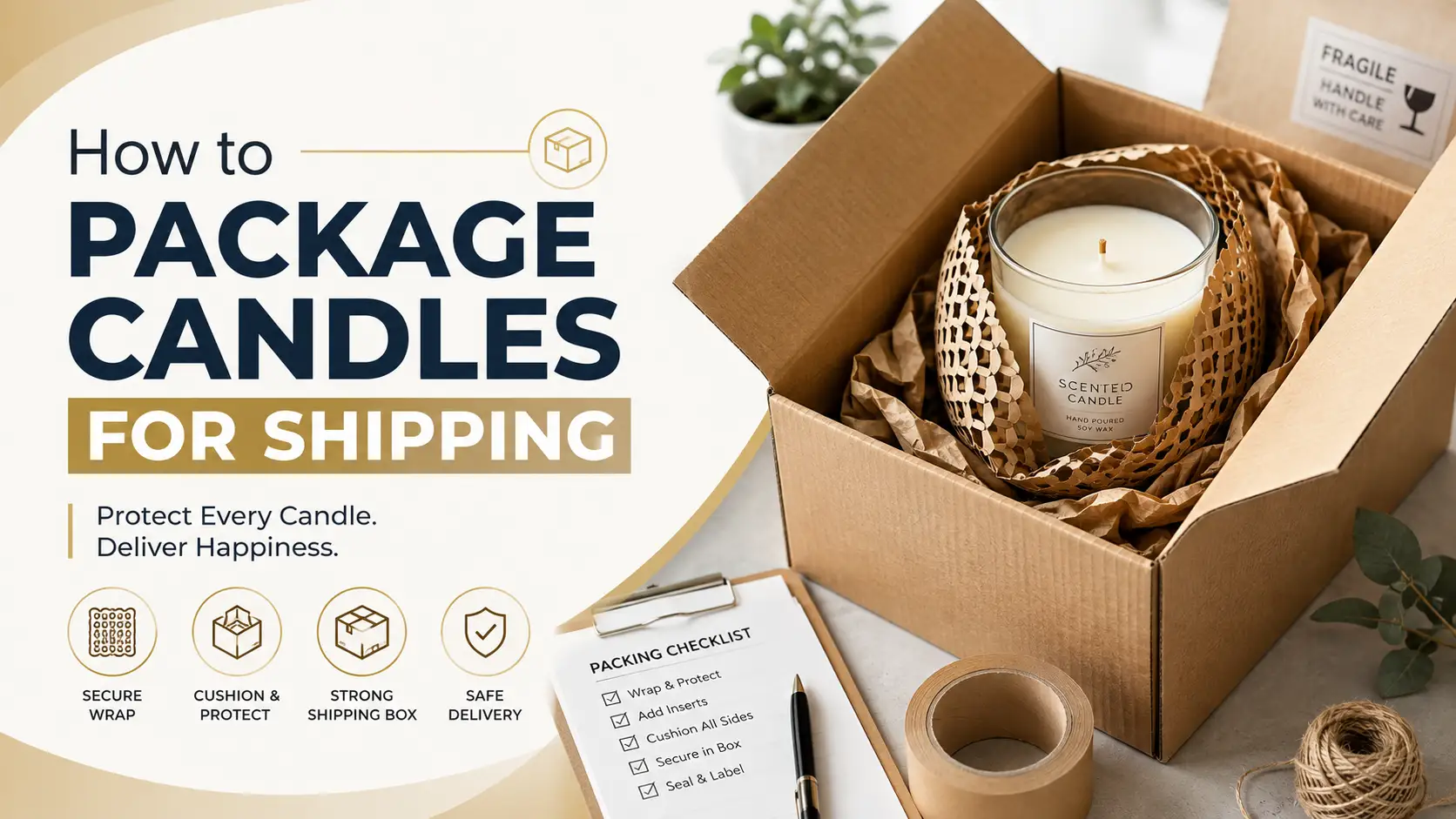
For most glass jar candles, use the following packing system:
- Check that the wax, label, lid, and jar are ready for dispatch.
- Wrap the jar with protective material.
- Place it inside a close-fitting product box or protective insert.
- Add cushioning beneath and around the candle.
- Pack it inside a strong corrugated shipping box.
- Fill every space.
- Run a shake test before sealing.
- Seal the parcel with strong packing tape.
- Test the packaging through a real courier journey before using it at scale.
The candle should not touch another candle or any wall of the outer box. Royal Mail also advises that fragile items should not touch each other or the sides of the container.
Why Candle Jars Break During Delivery
Most candle breakage is not caused by one major drop. It often comes from repeated small impacts, vibration, stacking pressure, and uncontrolled movement.
The jar moves inside the box
An oversized shipping box may look safer because it leaves more room for cushioning. In practice, excess space often allows the candle to gain momentum before hitting the side of the box.
The aim is not to remove all space. The aim is to create a controlled cushioning zone that holds the candle firmly without pressing hard against the glass.
The base receives a direct impact
The bottom of a candle jar often takes the greatest force when a parcel is dropped or placed heavily on a surface. A jar sitting directly on the box base has almost no protection from that impact.
Always place cushioning beneath the candle, not only around its sides.
Multiple jars knock together
Bubble wrap alone may not protect two heavy candle jars if they can move towards each other. Each jar should be individually protected and separated with strong dividers or fitted inserts.
The outer box collapses under weight
Candles are dense products. A box containing several glass candles can become heavy even when its dimensions are small.
A weak carton may crush when other parcels are stacked on top. The pressure can transfer through the cushioning and into the glass.
The wax becomes soft
Warm weather creates another risk. Wax may soften, move away from the jar wall, mark the lid, or affect the candle’s finished surface.
Long delivery times and warm storage areas increase this risk. Dispatch timing and delivery speed matter as much as the box itself.
Candle Packaging Materials You May Need
The best packaging for candles uses several layers. Each layer performs a different job.
| Packaging component | Main purpose | Suitable options |
| Jar wrap | Protects the surface and absorbs light impacts | Honeycomb paper, foam sheet or bubble wrap |
| Product box | Protects the jar and improves presentation | Close-fitting cardboard or corrugated candle box |
| Insert | Stops the candle moving | Die-cut cardboard, corrugated or moulded paper insert |
| Bottom cushion | Reduces force from drops | Crumpled paper, corrugated pad, foam or air cushioning |
| Void fill | Prevents movement inside the outer carton | Kraft paper, paper pads, air pillows or suitable loose fill |
| Outer shipping box | Handles stacking and courier pressure | Strong single-wall or double-wall corrugated box |
| Packing tape | Keeps the parcel closed | Reinforced or strong carton-sealing tape |
Avoid choosing a material only because it looks premium. The first question should always be: Will it keep the jar still during courier handling?
How to Package Candle Jars Step by Step
1. Inspect the candle before packing
Do not pack a candle immediately after production.
Make sure:
- The wax has fully set.
- The jar has no cracks, chips, or weak points.
- The lid fits correctly.
- The label and safety information are secure.
- Printed surfaces are dry.
- The wick is trimmed and protected from dust.
- There is no oil, wax, or fragrance residue on the outside of the jar.
Packing a damaged jar more carefully does not make it safe. Remove faulty jars before they reach the packing station.
2. Secure the lid
A loose lid can rub against the jar, damage the label, or come off during delivery.
Check the lid fit by lifting and gently turning the packed candle. When needed, use a removable paper seal, branded sticker, sleeve, or small strip of low-tack tape.
Do not use so much adhesive that the customer struggles to open the candle or receives a jar covered in residue.
3. Wrap the glass jar
Wrap the full jar, including the base and shoulder area. Pay close attention to any exposed rim or decorative edge.
Suitable protective options include:
- Honeycomb paper for a plastic-free presentation
- Corrugated paper wrap
- Foam sheet for surface protection
- Bubble wrap for stronger shock absorption
- A fitted protective sleeve
Use enough material to create a cushioning layer, but do not wrap so tightly that pressure is placed on thin glass.
Tape the wrapping to itself rather than directly onto the label or jar.
4. Protect the bottom
Place a cushioning pad at the bottom of the candle’s product box or shipping box.
This layer should be thick and even. A thin sheet of tissue paper may improve presentation, but it does not provide meaningful impact protection.
For heavier jars, use a corrugated pad, folded Kraft paper, foam base, or fitted insert that supports the jar across a wider area.
5. Place the candle in a fitted box or insert
A close-fitting candle box adds protection and creates a better unboxing experience. However, a retail candle box is not always strong enough to act as the shipping carton.
For glass candles, a useful system is:
- Wrapped candle jar
- Close-fitting retail or product box
- Protective insert or cushioning
- Corrugated outer shipping box
Custom jar boxes can be made around the dimensions of the candle and may use cardboard, corrugated board, Kraft board, or rigid board. The correct material should be selected according to the jar’s weight and whether the box is being used for retail display, postal protection, or both.
6. Choose a strong outer box
Use a new, Rigid corrugated box that is suitable for the packed weight.
Parcelforce recommends using a new rigid cardboard box and making sure the packaging is strong enough for the size and weight of the contents. It also advises individually packaging fragile glass items before placing them in a larger box.
Consider a double-wall shipping box when:
- The candle jar is large or heavy.
- More than one candle is being shipped.
- The order is travelling a long distance.
- The parcel may face heavy stacking.
- The product has a high replacement value.
- Previous deliveries have suffered corner or crush damage.
A strong single-wall box may be enough for a small, lightweight candle when it is properly fitted and tested. Do not assume double-wall board is always required, but do not reduce box strength only to save a small amount on packaging.
7. Fill every space
Once the candle is inside the outer box, fill the gaps around it.
Good void fill should:
- Stop side-to-side movement
- Stop vertical movement
- Absorb repeated vibration
- Prevent the candle from touching the box walls
- Stay in position throughout delivery
Crumpled paper works well when it is packed firmly and evenly. Thin tissue paper usually compresses too easily. Air pillows may fill large spaces, but they should not be the only protection around a heavy glass jar.
Do not overfill the box. Too much pressure can stress the jar or cause the box flaps to bow.
8. Run the shake test
Close the box without sealing it and shake it gently in several directions.
Listen and feel for movement.
If the candle shifts, rattles, or hits the box wall, open the parcel and improve the insert or void fill. A customer’s order should not become the packaging test.
The shake test does not replace drop or courier testing, but it can catch obvious packing errors before dispatch.
9. Seal the box properly
Use strong packing tape designed for cartons. Seal the centre opening and the two side edges so the top and bottom flaps cannot open during handling.
Do not use ordinary household tape, masking tape, string, or decorative ribbon as the main closure.
Keep the delivery label flat, visible, and away from box seams. Add the return address and place a copy of the delivery information inside the parcel when practical.
A “Fragile” label may encourage careful handling, but it does not replace protective packaging. Parcelforce also states that a fragile label is not a substitute for adequate packing and that parcel orientation cannot be guaranteed.
How to Pack One Candle Versus Multiple Candles
The safest packing method changes with the order size.
| Order type | Recommended setup | Main risk |
| One small jar candle | Wrapped jar, fitted box, cushioning and strong outer carton | Impact against the box wall |
| One large jar candle | Strong wrap, base pad, fitted insert and double-wall outer box | Weight and bottom impact |
| Two jar candles | Individually wrapped jars with a rigid divider | Jars hitting each other |
| Candle gift set | Die-cut insert holding each product separately | Different products moving together |
| Bulk candle order | Partitioned corrugated carton with layer pads | Stacking pressure and carton collapse |
For multiple candles, never rely on loose void fill alone. Heavy jars can push through paper or packing materials during repeated movement.
A divider should run high enough to prevent the jars meeting near the top of the box. Each candle should also have cushioning beneath it.
How to Ship Candles Safely in Hot Weather
Hot-weather shipping needs a separate plan. A box that works well in March may perform poorly during a summer heatwave.
Dispatch early in the week
Shipping on Monday or Tuesday can reduce the chance of a candle sitting in a warm depot over the weekend. Faster delivery services can also shorten heat exposure.
Check the weather across the delivery route
Do not look only at the temperature near your workshop. The parcel may travel through warmer parts of the UK or remain inside a delivery vehicle for several hours.
For international orders, check the destination climate and expected delivery time.
Use insulated packaging when needed
An insulated liner or thermal pouch can help slow temperature changes. It will not keep a candle cold forever, so it should be combined with a shorter delivery service.
Cold packs may help in extreme conditions, but they introduce condensation and extra weight. They should be separated from the candle and tested before regular use.
Protect the candle’s finished surface
Soft wax can mark against the lid or packaging. Allow a small amount of safe space above the wax surface and make sure the lid cannot press into it.
Set clear dispatch rules
A growing candle business should have a simple heat policy. This may include:
- Upgrading delivery during hot periods
- Pausing selected long-distance services
- Dispatching only on certain weekdays
- Using thermal packaging above an internal temperature limit
- Warning customers about possible delivery delays
A clear rule is easier for packing staff to follow than making a new decision for every order.
How to Post Candles in the UK
Candles can normally be sent through UK parcel networks, but the sender remains responsible for suitable packaging and for checking the chosen service’s current terms.
Before posting:
- Weigh the fully packed parcel.
- Measure the outer box accurately.
- Check the carrier’s size and weight limits.
- Confirm whether glass is covered for damage.
- Check destination restrictions for international orders.
- Use a tracked service for higher-value orders.
- Keep packing records and proof of value.
- Photograph high-value parcels before sealing when useful.
Carrier compensation should not be treated as a substitute for packaging. Parcelforce currently lists items made wholly or partly from glass among goods excluded from compensation for damage. Businesses should compare the exact terms of each courier before choosing a service for glass candle jars.
International deliveries may also require customs information, including an accurate product description, quantity, value, origin, and tariff details.
Choosing the Right Candle Shipping Box
The box should be designed around the packed candle, not only the bare jar.
Measure:
- Jar width
- Jar height
- Lid width and height
- Finished product weight
- Thickness of the protective wrap
- Required space for the insert
- Cushioning beneath and above the jar
- Number of candles per parcel
A box measured only from the glass dimensions may become too tight once the wrap and insert are added.
Custom-sized boxes reduce movement
A close-fitting box can reduce excess void fill, improve packing speed, use less storage space, and create a cleaner customer experience.
OneStep CustomBoxes offers custom shipping boxes with corrugated, cardboard, Kraft, rigid, and eco-stock options. Inserts, dividers, sleeves, and custom die-cut structures can also be used for fragile products such as candle jars.
For a useful packaging recommendation, provide the supplier with:
- A physical candle sample where possible
- Exact jar and lid dimensions
- Product weight
- Number of candles sent per order
- Current damage problems
- Preferred courier
- Order volume
- Branding requirements
- Storage limits
- Sustainability goals
A packaging supplier cannot make a reliable strength recommendation from a logo and jar photo alone.
Common Candle Shipping Mistakes
Using the gift box as the shipping box
A premium rigid or folding carton may present the candle beautifully, but it may not survive rain, stacking, drops, or sorting equipment.
Protect the presentation box with a suitable outer shipping carton.
Choosing a box that is too large
A bigger box may increase void fill, postage costs, packing time, and product movement.
Use the smallest box that still allows a proper cushioning zone.
Wrapping the jar but leaving it loose
A thick layer of bubble wrap cannot help much if the wrapped candle travels across the box and hits the opposite wall.
Wrapping absorbs impact. Inserts and void fill control movement. Both are needed.
Allowing jars to touch
Never let glass jars share direct contact, even when each one is wrapped. Add dividers or separate compartments.
Packing too tightly
Glass can also break when strong pressure is applied from every side. Cushioning should hold the product, not crush it.
Ignoring the parcel’s total weight
The correct box for one candle may fail when four candles are packed inside it.
Reassess the board strength and insert design for every common order quantity.
Trusting a fragile sticker
Courier networks use conveyor belts, cages, vans, depots, and automated sorting systems. The parcel must be able to survive normal handling without relying on special treatment.
Skipping trial shipments
A box may pass a desk test but fail after vibration, temperature changes, stacking, and repeated drops.
Send trial parcels to different UK addresses before placing a large packaging order.
Build a Repeatable Candle Packing Process
Consistent packing matters as much as good materials.
Create a packing specification for each candle size. It should show:
- The correct box code
- The amount and type of wrap
- Insert position
- Void-fill method
- Tape pattern
- Finished parcel weight
- Delivery service
- Hot-weather changes
- Final quality checks
Train every packer to follow the same process. One person may pack paper firmly while another leaves it loose. That small difference can change how the parcel performs.
Track damage by:
- Candle size
- Jar supplier
- Box type
- Courier
- Destination
- Number of candles
- Weather conditions
- Type of breakage
A cracked base points to a different problem from a crushed lid or broken side wall. Damage records help identify whether the cause is the jar, insert, box, packing method, or courier route.
Can Candle Packaging Be Protective and Recyclable?
Yes, but sustainability should not reduce product safety.
A broken candle wastes the jar, wax, fragrance, label, packaging, production time, delivery cost, and replacement shipment. Using less material is not sustainable when it causes more damage.
Practical options include:
- Right-sized corrugated boxes
- Recyclable cardboard inserts
- Moulded paper supports
- Honeycomb paper wrap
- Kraft paper void fill
- Minimal print coverage
- Clearly separated packaging materials
- Packaging that customers can reuse or recycle easily
Test paper-based materials under real shipping conditions. Some paper fillers settle or compress during long journeys, especially around heavy jars.
Safer Candle Delivery Starts With Better Box Design
The safest candle parcel is not the one with the most packaging. It is the one in which every layer has a clear purpose.
The jar needs surface protection. The insert needs to stop movement. The cushioning needs to absorb impact. The outer box needs to handle weight and stacking. The packing process needs to deliver the same result every time.
OneStep CustomBoxes can create custom candle jar boxes, protective inserts, dividers, mailer boxes, and corrugated shipping boxes around your product dimensions and order needs.
Request a packaging sample or get a free quote to compare the box fit, board strength, insert design, print quality, and packing time before committing to a larger order.
Frequently Asked Questions
1. What is the best packaging for shipping candles?
The best setup for a glass candle is a wrapped jar, fitted product box or insert, cushioning on every side, and a strong corrugated outer box. Heavy or multiple candles may need double-wall board.
2. How much bubble wrap should I use for a candle jar?
Use enough wrap to protect the whole jar and prevent direct contact with hard surfaces. The correct amount depends on the jar weight, glass thickness, box fit, insert design, and delivery route. Test the completed parcel rather than relying on a fixed number of layers.
3. Should glass candles be double-boxed?
Double-boxing is useful for large, heavy, high-value, or especially fragile candles. It is also worth considering for international delivery. A small jar may not need two full boxes when it has a strong fitted insert and a suitable corrugated outer carton.
4. How do I stop candles breaking in transit?
Stop the candle from moving, protect the base, prevent contact with the outer box, use a carton suitable for the total weight, and separate multiple jars with rigid dividers. Trial shipments should be completed before large-scale dispatch.
5. Can I send candles through Royal Mail?
Candles can generally be posted, but you should check the current service rules, destination restrictions, parcel limits, and compensation terms before dispatch. Glass jars must be packed as fragile items.
6. How should I pack several glass candles together?
Wrap each candle separately and place each jar in its own compartment. Use strong dividers, a supportive base layer, top cushioning, and an outer box rated for the combined weight.
7. How do I prevent candles from melting during shipping?
Dispatch early in the week, choose a faster service during warm weather, use insulated packaging when needed, and avoid leaving parcels in warm storage areas. Test your packaging with the specific wax and jar combination you sell.
8. Is a fragile sticker enough for candle shipping?
No. A fragile sticker may identify the parcel, but it does not prevent movement, crushing, or impact. The box must protect the candle without depending on special handling.
9. What is the cheapest way to post candles in the UK?
The lowest total cost usually comes from right-sized packaging that prevents damage without adding unnecessary weight. A weak box may reduce the first shipping cost but create higher replacement, refund, and customer service costs.
10. Are custom candle box inserts worth the cost?
They are often valuable for regular orders, heavy jars, gift sets, or premium products. Inserts can reduce packing time, control movement, improve presentation, and make packaging results more consistent.